Monday, October 1, 2012

New Blog!

Looking Glasses at Odd Corners has moved! This site will remain live, but posts and information, old and new, have now been moved and updated.

Please visit: http://amberregis.com for the continuing adventures of this life-writing researcher...

Thursday, June 14, 2012

Publication: Early Career Victorianists and Social Media (JVC 17.3 -- iFirst release)


Just a quick post to announce the publication of my article on academic blogging and tweeting:


It will appear in the autumn issue of the journal, but has been released early via iFirst alongside Rohan Maitzen’s article on ‘Scholarship 2.0: Blogging and/as Academic Practice’.

My article was written with the help of fellow bloggers Charlotte Mathieson, Bob Nicholson and Paul Dobraszczyk. It also owes a heavy debt to the various online communities fostered by social media and brought together via Twitter hastags: #phdchat #phdadvice #acwri #academia #highered #loveHE #twitterstorians #twitcrit #twitterature to name but a few!

Wednesday, June 6, 2012

Book Chapter: Contradictory Woolf

Just a quick post to announce the publication of my book chapter on Virginia Woolf’s Roger Fry (1940), the Omega Workshops and her contradictory theorising of biography:

‘"But something betwixt and between": Roger Fry and the contradictions of biography’, in Contradictory Woolf, ed. by Derek Ryan and Stella Bolaki (Clemson: Clemson University Digital Press, 2012), pp. 82-7

This chapter forms part of an edited collection emerging from the 21st Annual International Conference on Virginia Woolf, held at the University of Glasgow in June 2011. Print copies are available to order, but I’m very happy to see the online version is open access. [The series back catalogue is also available online, and I have a chapter on Orlando (1928) and the ‘limits’ of biographical representation in Woolfian Boundaries (2007).]

Although the paper evolved during the writing process, becoming increasingly concerned with the relationship between Woolf's theories of biography and Fry's theories of art and craft, I thought I would whet your appetite with a glimpse of my original abstract:
"But something betwixt and between": Roger Fry and the contradictions of biography
He chooses; he synthesises; in short, he has ceased to be the chronicler; he has become an artist. (‘The New Biography’, 1927)
And thus we come to the conclusion, that he is a craftsman, not an artist; and his work is not a work of art, but something betwixt and between. (‘The Art of Biography’, 1939) 
Virginia Woolf’s Roger Fry (1940) remains the black sheep of the Woolfian canon. No critical edition is currently in print. It is conspicuously absent from the Penguin and Oxford ‘Classics’ lists, and though Vintage reproduces the text as part of its ‘Lives’ series, there is no scholarly introduction or editorial apparatus. It seems that Roger (to appropriate Woolf’s nickname for the work) has a bad reputation. This is due, in large part, to Woolf’s own response. In her diaries and letters, Roger becomes ‘donkey work & […] sober drudgery’, or nothing more than ‘a piece of cabinet making’. But it is the connection between Roger and ‘The Art of Biography’ that strikes the fatal blow.
This paper will explore Woolf’s contradictory theorising of biography, from the optimism of ‘The New Biography’ to the seeming retractions of ‘The Art of Biography’. Woolf bestows and then strips biography of its claim to art, with the result that Roger (contemporaneous with ‘The Art of Biography’) has been read as an embodiment of its conservative aesthetic. I will argue, however, that Woolf’s later writing on biography, far from enacting a volte face, serves to develop and adapt her earlier position. As such, I will offer a reassessment of Roger, using its method and practice to demonstrate an ongoing Woolfian experiment. In Roger, as in her earlier biographical works, Woolf exploits the productiveness of paradox and contradiction—that ‘something betwixt and between’ at the heart of ‘The Art of Biography’.

Saturday, May 5, 2012

JVC Bloggers Fair

The Journal of Victorian Culture Online website is staging a Bloggers Fair this month. Each day a new blog is featured; the author reflects on its content and discusses their motive(s) for writing.  So far, Rohan Maitzen’s Novel Readings and Mark Blacklock’s The Fairyland of Geometry have enjoyed the spotlight, as has Looking Glasses At Odd Corners.

Looking Glasses At Odd Corners as featured in the JVC Online Bloggers Fair,
2 May 2012

A feature on this blog was used to ‘launch’ the Bloggers Fair and very soon my article on early career Victorianists and social media will be published (and made open access). This article will, I hope, help to contextualise JVC's Bloggers Fair by exploring the processes, purposes and motives at work in the Victorian (and neo-Victorian) blogosphere.


I will update the following list as the Bloggers Fair progresses:

Life-writing and life narrative across media and genres.


2. The Fairyland of Geometry by Mark Blacklock
Nineteenth-century engagements with ‘higher dimensional’ space.


3. Novel Readings by Rohan Maitzen
Reflections on reading, research and teaching.


4. Art and Perfume by Christina Bradstreet
Smell in nineteenth-century art and culture.


5. A Special Mention by Gaby Malcolm
Reflections on research, with particular reference to Mary Braddon.


6. The Old Curiosity Shop by Jolette Roodt
Links to Victorian-related websites and posts that focus on new books about the period.


7. Research Blog and Teaching Blog by Charlotte Mathieson
Reflections, reviews and discussions of nineteenth-century literature and contemporary resonances.


8. Neo-Victorian Thoughts by Louisa Yates
Reflections on how the Victorians and Victoriana reveal themselves in contemporary culture.


9. Girls' Literature and Culture by Michelle Smith
Reflections on how girls are situated in nineteenth-century and contemporary popular culture.


10. Scotland's History Uncovered by Lynne Wilson
Scottish social history, with particular reference to the Victorian period.


11. North East Nineteenth Century by the North East Postgraduate Research Group for the Long Nineteenth Century
Community blog run by postgraduates at the Universities of Newcastle, Northumbria and Durham. Events, calls for papers, discussion and information about group members.

Sunday, April 29, 2012

Nineteenth-Century Memory: On Biography, Forgetfulness and Not Knowing

Sundial, St Peter's Church, Norton Disney
Photograph by J. Hannan-Briggs
Used under the Creative Commons License
In March this year I attended a conference at Leeds Trinity University College on the theme of Nineteenth-Century Memory: Approaches and Appropriations. Papers ranged broadly, from Victorian accounts of the recent past to NeoVictorian re-imaginings, from trauma and melancholy to tropes of time passing.

Of particular interest to me were papers on the subject of memory and life narrative, including Jo Taylor (Keele) on the posthumous reputation of Samuel Taylor Coleridge as shaped by the editorship of his children, Sara and Hartley, and Hana Leaper (Liverpool) who traced the influence of Leslie Stephen’s Mausoleum Book on the work of Virginia Woolf and Vanessa Bell. And it was Victorian biography -- a much-maligned genre -- that provided the subject matter for Trev Lynn Broughton’s (York) opening keynote on the topic of “remembering” and “forgetting”.

Broughton challenged the notion that remembering and forgetting are opposite terms. To forget something, she argued, was not simply a case of failing to remember. Turning to biography, so often seen (in its Victorian manifestation) as a ‘site and sign of repression’, a literary form in thrall to censorship and reticence, forgetfulness can be read as a creative act. In organising a life into a coherent narrative, biography is necessarily selective; it chooses what memories to transmit to a new generation of readers, and it chooses what elements to pass over, to omit or obscure. For Broughton, therefore, biographies are both a ‘memorial’ and a ‘site of burial’ -- in remembering their  subject, they demonstrate the importance of forgetting.

The endlessly re-tellable nature of life narratives supports this reading of biography as a product of forgetfulness. With each new version of a life -- with each new claim to have written the “definitive” account -- different elements are remembered and forgotten, different memories are uncovered and buried. But is it ever possible (or desirable) to remember and memorialise a life both entire and complete? Alongside remembering and forgetting, should we consider the problem of not knowing?

In 1927, E.M. Forster delivered the Clarke Lectures at Trinity College, Cambridge, published later that year under the title Aspects of the Novel. In these lectures Forster drew a distinction between ‘Homo Fictus’, the species of human living in fiction, and ‘Homo Sapiens’, the species of human living in history [1]. What separates these different classes of being is their un/knowability:

In daily life we never understand each other, neither complete clairvoyance nor complete confessional exists. But people in a novel can be understood completely by the reader, if the novelist wishes; their inner as well as their outer life can be exposed. We cannot understand each other, except in a rough and ready way; we cannot reveal ourselves, even when we want to; what we call intimacy is only makeshift; perfect knowledge is an illusion. But in the novel we can know people perfectly. [2]

It is beyond the scope of this blog post to debate Forster’s claims for status of characters in fiction, but his account of the unknowability of ‘Homo Sapiens’ helps shed a light on the vitality of remembering and forgetting in life-writing. If our knowledge of a biographical subject is ‘illusive’, then remembering and forgetting are the means by which we construct this illusion. In remembering certain elements and forgetting others, we cover and smooth the gaps and fractures -- we can thus stake a (false) claim to the “definitive” life. And yet, it is the unknowable nature of ‘Homo Sapiens’ -- the very impossibility of ‘clairvoyance’ or ‘complete confessional’ -- that empowers the biographer to remember and forget, which guarantees the re-telling, the re-writing, the re-membering of a life narrative.


[1] E.M. Forster [1927], Aspects of the Novel (London: Edward Arnold, 1945), p. 78.
[2] Forster, Aspects of the Novel, pp. 67-8.

Saturday, April 7, 2012

Review Essay on Victorian Life-Writing (JVC 17.1)

A quick post to announce the publication of my review essay on recent studies of Victorian life-writing in the Journal of Victorian Culture.


Both are ambitious and important studies. They help to redress a long-standing critical tradition that 'jumps over' the nineteenth century when constructing an account of innovation, dismissing the Victorian period as a time of reactionary conservatism in the writing of lives. These works are highly recommended!


Sunday, March 4, 2012

Blog in the News: On Self-Promotion and Networking

Waiting by Dave Walker
Source: We Blog Cartoons
While a busy teaching schedule and writing projects have been keeping me away from the blog over the last few weeks, the blog has been active in my absence. Others have been taking notice, and the blog has been featured on the Journal of Victorian Culture Online website, in the Times Higher Education, and has even received a special mention at a Victorian Studies conference.

Last year I wrote a post inspired by the different life narratives emerging from two very similar objects: Victorian decoupage screens. In turn, this was quoted by Charlotte Mathieson in a short essay exploring literary tourism and readers’ responses to place. Mathieson has now revised this post for the Journal of Victorian Culture Online, providing a timely contribution to Dickens 2012 bicentenary debates. As a result, my blog has enjoyed increased traffic with readers clicking through…

Posts exploring the phenomenon of celebrity memoir have also been revived. Responding to a tweet from @TimesHigherArts asking followers to confess their guilty reading pleasures, I got in touch and admitted to reading Dawn French’s Dear Fatty, and what is more, declared I was willing to defend it in print! The result was a short snippet in the Times Higher Education’s ‘What Are You Reading?’ column -- a few words in defence of celebrity memoir and a link to my blog post reviewing the work.

And then, yesterday, I was sitting in the audience of a keynote lecture at a conference on Nineteenth-Century Memory: Approaches and Appropriations (held at Leeds Trinity University College) when my blog was mentioned in the Q&A session. Trev Broughton had delivered a fascinating talk on memory and forgetting in Victorian biography, part of which compared the urge to produce biography to the desire for souvenirs (i.e. biography as an aide-mémoire, sustaining the presence of something -- or someone -- past). I put up my hand and asked about the emergence of biographical series (such as Morley’s ‘English Men of Letters’) and how these might relate to the act of collecting souvenirs. In her response, Broughton referenced my post on souvenirs and self-fashioning (and the picture of me with a Bronte tea towel!) as a spur to her reading of souvenirs, biography and memory. In addition to being terribly flattering, this mention prompted several delegates to approach me and ask about the blog. The post in question has since received several hits and Google searches...

So what’s the value of all this shameless self-promotion? The three instances listed above provide a useful demonstration of the benefits of engaging with social media as an academic, particularly an early career academic: attention has been drawn to my work, I have engaged directly with other researchers on the social web, and I have forged new connections with new readers. Social media has thus helped me to ‘network’ – an oft-dreaded activity that used to be confined to the in-between times at conferences, involving awkward conversations over coffee cups. But networking can now extend beyond the temporal and physical space of a conference; conversations can start before an event and continue long after, with connections being made online. In fact, networking is no longer the preserve of conferences and other research events; plugged-in academics are networked and networking all the time.

Communities on the social web were a recurrent theme in my recent research into early career Victorianists’ use of blogging and Twitter. I have just completed a short article on this topic, the writing of which was a collegial affair: commissioned as a result of my blogging activity, and drawing on case studies and contributions from #phdchat and #phdpostdoc Twitter communities. So yes, all this blogging and tweeting is a form of shameless self-promotion, but it’s also something more. The clue is in the name: social media and the social web. It’s about making connections, forming communities, offering support. In getting your name ‘out there’, you are not a voice crying out in the wilderness. A blog ‘in the news’ is a blog in conversation.


Update: A revised version of this post has been published on the PhD2Published website.

Sunday, February 5, 2012

On Academic Blogging

Become a Famous Blogger by Dave Walker
Source: We Blog Cartoons
I’ve been thinking a lot about blogging recently, and about academic blogging in particular. Why do academics turn to the blogosphere? What motives lurk behind this practice, and how do academics perceive their online identity? Do they view their online presence as part of, or separate from, the multiple performances that comprise their professional identity, e.g. conference participation, print publication and teaching?

Over the last few days I’ve put together a rather crude questionnaire intended to probe academic bloggers, to get an insight into their motives, uses and the benefits of their blogging activities. Since the result of my ponderings will be distilled into an article for a Victorianist journal, I have sent this questionnaire to three bloggers working in the broad field of Victorian Studies:


  • Charlotte Mathieson, a literary scholar and Associate Fellow at the University of Warwick. Charlotte blogs on two institution-hosted sites: her own research blog dedicated to her work on mobility and travel in the nineteenth century, and she contributes to 'Researcher Life', a communal blog designed to support early-career researchers.

  • Bob Nicholson, an historian and doctoral student at the University of Manchester who has recently taken up a Lectureship at Swansea University. Bob­—or his online alter-ego—blogs at ‘The Digital Victorianist’ site, complete with his own logo. As the name suggests, one of Bob's many interests is the impact of digital and online technologies on humanities research.

If you are not familiar with these blogs, I urge you to visit and explore!


You may have noticed a further link between these three 'case study' bloggers, something other than their shared interest in all things Victorian. All are early-career researchers, much like myself (all this means is that the PhD is being worked towards, or has been awarded in recent years—eight years, for the purposes of the AHRC). I’m particularly interested in why these young, up-and-coming researchers have turned to social media, and I’m looking forward to receiving their responses to the questionnaire!

All this questioning of others, however, has made me consider more closely my own motives for starting a blog. In the first instance, I wanted to write something that people might actually read (doctoral theses tend to collect dust on University library shelves) and to do this in a style, a language that was more conversational, more open and less exclusive than the ‘academic voice’ I had used elsewhere. I also wanted to get beyond the Victorian and the early-modernist period, much as I love them. I wanted to extend my interest in life narratives beyond the boundaries I had previously set in my research, broadening my view to include contemporary events, new media, film and television. Though, if you scan through my posts, you will find a lot of Victorian-inspired delights, you’ll also find posts on biopic, documentary, Monty Python and souvenir tea-towels (yes, seriously). I wanted to make the process of research visible (in posts such as this) as well as the polished final product. And yes, I wanted to raise my profile, to engage in shameless self-promotion -- the nebulous concept of 'impact' is something I will have to tackle as I write the article.

I’ll be examining these motives more closely as I write my article over the next few weeks, and it will be an interesting challenge to adopt this reflective writing position.

But dear reader, do you blog? And why? What are the reasons and what are the benefits? Pray, do tell…

Monday, January 30, 2012

Virginia Woolf Birthday Lecture, 28 January 2012

Virginia Woolf (photographed in 1902)
by George Charles Beresford
Source: Wikipedia
Last Saturday I travelled down to London for the annual Virginia Woolf birthday lecture organised by the Virginia Woolf Society of Great Britain. Fittingly, the event was held in the Keynes Library at 43 Gordon Square, complete with Vanessa Bell paintings looking down upon the audience from the rather grand walls. There was birthday cake and champagne, and a fascinating lecture by Michael Whitworth on the topic of ‘Virginia Woolf, Fame and Gloire’.

Whitworth traced the nuances of fame, reputation and ‘afterlives’ as debated and explored in Woolf’s fiction, essays and her correspondence with Logan Pearsall Smith. Ranging from Night and Day to Between the Acts -- and taking in Jacob’s Room, To The Lighthouse and Orlando along the way -- Whitworth teased out the multiple meanings of fame and longevity in Woolf’s work. What is the relationship between the celebrity of an author and the value of a text? Is fame to be measured in terms of money, revenue and sales? Or is it the product of genius and the result of a lasting work of art? And where is the book as physical object in all this? What is the relationship, if any, between the preservation of pages and bindings, and preservation of a writers’ reputation?

An extended version of Whitworth’s lecture will soon be published and available to buy from the VWSGB, and I look forward to getting my hands on a copy. As a life-writing researcher, I was intrigued by the questions raised and Whitworth’s exploration of the relationship between authors (or author figures in fiction) and texts, between authors and books. For Whitworth, Logan Pearsall Smith -- with whom Woolf debated the issue of fame, defending modern writers against accusations of debased chasing after money -- provided the model for Nick Greene in Orlando (revising a critical tradition that would have Edmund Gosse as the template for this character). As readers, we are invited to suspect Nick Greene and his championing of ‘gloire’; he is vulgar, grotesque and his views seem detached from the realities of the writing and book trade, from the vitality of writing as it is practised now, with his head stuck firmly in the past. But the reference to Nick Greene set my mind to thinking about a different aspect of fame, reputation and ‘afterlives’…

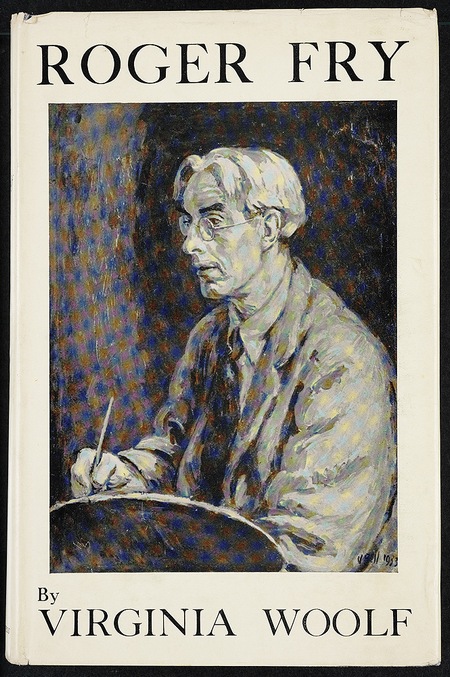
Virginia Woolf, Roger Fry: A Biography (1940)
Source: www.mantex.co.uk
Nick Greene writes a satire of his patron Orlando; as such, the ‘gloire’ of his poem depends on the cannibalised reputation of another. Orlando as a novel is a mock-biography of Vita Sackville-West and much of its humour and playfulness depends on the reputation (and infamy) of its subject. While Woolf was writing Between the Acts and exploring the lastingness -- or rather, the “scraps, orts, and fragments” [1] -- of a work of art, she was also writing her life of Roger Fry, a book that would cause much difficulty in the writing, not least because of the responsibility she felt to friends and family to ‘capture’ Roger, yet also to preserve and protect his reputation. When dealing with his affair with her sister, Vanessa Bell, Woolf exclaimed: “What am I to say about you? […] Do give me some views; how to deal with love so that we’re not all blushing” [2].

In the case of Roger Fry, the fame and reputation of the biographer was intimately tied to, and responsible for, the fame and reputation of the biographical subject. It is striking, therefore, that Roger Fry is the most forgotten, most neglected of Woolf’s major works; it enjoys the least fame and the most doubted, the most questioned reputation. (It is, however, a fascinating biography offering a sensitive and experimental account of Fry’s life -- but this is an argument for another day.)

Literary biography is a pertinent genre for an exploration of fame and longevity: of text, of subject, of biographer. And thus, when the published version of Whitworth’s lecture arrives through my letterbox, I’ll be keen to see how its arguments relate to Woolf’s career-long interest in the writing of lives.

[1] Virginia Woolf, Between the Acts, ed. by Frank Kermode (Oxford: Oxford University Press, 2008), p. 169.

[2] Virginia Woolf to Vanessa Bell, 8 October 1938. Leave The Letters Till We’re Dead. The Letters of Virginia Woolf, Volume Six: 1936-1941, ed. by Nigel Nicolson and Joanne Trautmann (London: The Hogarth Press, 1980, p. 285.

Saturday, January 21, 2012

TLS, 20 January 2012

Just a quick note to announce the publication of my ‘In Brief’ review of Richard Locke’s Critical Children: The Use of Childhood in Ten Great Novels (New York: Columbia University Press, 2011) in this week’s Times Literary Supplement (20 January 2012).

Source: Columbia University Press

Locke’s study accomplishes that difficult task of balancing astute criticism with readability; his chapters perform elegant and absorbing close readings, and will no doubt captivate both academic and popular audiences. Highly recommended!

Wednesday, January 18, 2012

On Blogging and Being Busy

Little Crackers
Source: Sky 1
Regular visitors to the blog will no doubt have realised this is not the long awaited third instalment of my series on celebrity memoir. Be assured this post is on its way and will feature a discussion of Little Crackers, a series of mini celebrity biopics aired on Sky 1 over Christmas.

But in my first post, I described this blog as ‘a life narrative of my very own’. And so, it only seems appropriate that I interject a brief, autobiographical account of what I’ve been up to, the projects I have on the go, and how these relate not only to life narrative, but also to the act of blogging.

What’s the phrase? We apologise for the disruption, normal blogging services will be resumed as soon as possible. But why the disruption? In brief, I’ve been busy. January has brought with it the beginning of a new semester and an increased teaching load. But there is much to look forward to, and two of the modules I am teaching will involve the study of life narratives. (Life writing continues to be under-represented on university syllabi, most often limited to specialist modules, read in isolation, and only rarely alongside other texts and genres.)

An Account of the Trial Execution and
Dying Behaviour of Henry Fauntleroy (1824)
Source: Criminal Broadsides Project
Harvard Law School Library
In Prison Voices at LJMU I will be making use of eighteenth- and nineteenth-century criminal broadsides (many courtesy of the Old Bailey Online). Published and sold to accompany public executions, these pamphlets contain the fictive, “ventriloquised” confessions and laments of criminals -- a macabre souvenir of the day.

I will also be teaching a survey course for the Open University on The Arts Past and Present (AA100). The module ranges across disciplines, from philosophy to music, religion to architecture, literature to film. The course is arranged into four thematic books, the first of which is titled Reputations. This book investigates the concept of fame (and infamy) and how the biographical/historical record shifts and changes, how lives are constructed and reconstructed, how reputations wax and wane, ebb and flow.

This has been a topic of interest in my own work, and last year I published an article exploring competing accounts of Vita Sackville-West’s life and how her sexuality has been subject to successive concealments and revelations. It will be a treat to return to these issues, to investigate new and different case studies (and these will include Cleopatra, Stalin and the Dalai Lama).

I’ve also had a few exciting commissions in recent weeks. I’ve been invited to become a guest blogger at JVC Online (the virtual counterpart to the academic journal, Journal of Victorian Culture). So keep a look out for link ups and re-posts between this blog and JVC Online!

I’ve also been invited to write a short article on blogging and Twitter in the field of Victorian Studies. Now this may raise a few eyebrows. Academics have a reputation for resembling their research and many terrible stereotypes result: historians are as dusty as archives; artists are bohemian; mathematicians are bespectacled and methodical. From the outside looking in, therefore, Victorian Studies might not seem particularly fertile ground – surely we’d all be happier communicating via the telegraph and through letters with a penny black stamp? Well, you might be surprised. There are so many interesting Victorian bloggers and tweeters, and the field of Victorian Studies has produced a vast and diverse array of digital projects, such as the Nineteenth-Century Serials Edition, the Database of Mid-Victorian Wood-Engraved Illustration, and Charles Darwin Online (to name but a very few).

As I set out on my adventures through the Victorian Studies blogosphere, look out for posts and tweets asking for your opinions and input. To what uses are blogs and Twitter put in the field of Victorian Studies? Do users represent a distinct demographic? Are they PhD students and early career academics? Are they on the receiving end of bemused looks and skepticism from more senior (and older) colleagues? Or, is this an unfair distinction? What identities are adopted and performed by Victorian Studies academic and enthusiasts in the blogosphere and on Twitter? I’ll be considering all of these questions in the coming weeks, so get your thinking caps on!

Thank you for your patience; normal blogging services will now resume…

Friday, December 30, 2011

Top of the Blog: 2011

And so 2011 is drawing to a close, and so too is my first year in the blogosphere. What has surprised me most is the breadth of readership and the distance a blog post can travel. Though one can see changes in academe, particularly with the rise of open-access publishing, the audience I can reach here far outstrips that enjoyed by work I’ve published more 'formally'.

Here I am able to explore tentative new ideas, those musings and wonderings that will form the basis of future research topics and projects. I am also able to explore new themes, new genres and new historical periods. In particular, I have enjoyed writing about popular culture and the contemporary moment, the worlds of film and television. And it is these posts that top my 2011 ‘hit parade’, my top three (well, top four, since I have a joint-third) ‘most read’ posts of the year:

1          Holy Flying Circus


Thanks for reading and thanks for commenting -- for turning the experience of blogging into a dialogue, a conversation. I look forward to writing more posts in 2012 (and look out for my next on celebrity mini-biopic, the third in a series on celebrity memoir at Christmas). I’ll also be writing a short article on blogging, Twitter and their impact/uses in the field of Victorian Studies, so please look out for posts and tweets asking for your thoughts and experiences!

Wishing you a very prosperous 2012.

Wednesday, December 21, 2011

Celebrity Memoir II: Dear Fatty

Last week I blogged about the Christmas trade in celebrity memoir, and by coincidence or serendipity, last Friday’s Guardian Books podcast contained a segment on the genre. In it, Claire Armitstead interviews John Harris, a Guardian writer whose recent article in the G2 pitted ‘sleb tome against ‘sleb tome, seeking (with tongue in cheek) the ultimate celebrity memoir. Harris is asked (in a somewhat leading fashion) whether the quality of these works is responsible for their falling sales; he replies in a familiar strain: “I would like to think, having now read close to twenty of these things, that […] the penny is starting to drop with the reading public and they’re realising, by and large, what an awful, awful thing these are and therefore stepping away.’

So much for the sympathetic stance of the Guardian described in my last post. But are they really ‘awful, awful’ things? And will reading them really drive you mad (as Harris claims earlier in the podcast)? I have already suggested that the press coverage ‘enjoyed’ by celebrity memoir, with its refusal to recognise the legitimacy of the form, is steeped in literary snobbishness. But might this stance be justified? To answer these questions, I’ve had to delve beneath the (celebrity memoir) covers…

This last week I’ve been casting an eye over Dawn French’s bestselling 2008 memoir, Dear Fatty. In terms of viewing celebrity memoir as a Christmas trade -- as a cynical, money-making collusion between ‘star’ and publisher -- this title seems to fit the bill and adhere to stereotypes. In April 2007, The Sunday Times reported that a bidding war had broken out, with publishers fighting over French’s then unwritten memoir. A week later, it reported that £2 million had been paid, with Century (part of Random House) winning the battle. Dear Fatty was also a popular success, selling more than 344, 857 copies by 6 December 2008 -- something sure to raise the hackles and suspicions of the literary establishment.

I freely confess to being surprised by Dear Fatty. First of all, it demonstrates a sophisticated awareness of genre, its limits and traditions. French resists the linear, Bildungsroman plot of much autobiography, and rejects this as a label for her work: “I have decided to think of this book as a memoir rather than an autobiography” (ix). Now, “memoir” is the term most commonly applied to celebrity works -- and it is also the description I have used, for the sake of clarity. However, one suspects that memoir is often applied in a derogatory sense, suggesting an inability to reach and attain the dizzy heights of autobiographical aesthetic unity and coherence. But French embraces the fragmentary, the disruptions to chronology, the biases associated with memoir. Rather than tell her story in a logical, ordered fashion, she will focus instead “on those memories that are especially important or vivid to me. The parts of my life I can still remember the taste and feel and smell of” (ix) [1].

These stand-out moments, encounters and events are narrated, not in flowing retrospective prose, but in a series of letters to various significant others: mother, dead father, brother, niece, daughter, old boyfriends, Jennifer Saunders, Lenny Henry, etc. Each letter assumes a different audience, and thus necessitates a different performance -- a different epistolary self (to borrow a phrase from life-writing theory). Letters to the absent father, who committed suicide when French was just nineteen, strike a plaintive, melancholic note without recourse to cloying sentiment or indulgent prose. Letters to ‘Fatty’ (French’s nickname for Saunders and a playful sleight of hand undermining reader’s expectations, the common assumption that ‘Fatty’ is French herself), by contrast, adopt an intimate and confessional tone, something akin to a (jocular) therapist’s couch. Interrupting this succession of relational selves, where each addressee shapes the autobiographical subject, is the occasional comic letter, including several to Madonna (who never agreed to appear io a French and Saunders show), fan-mail to David Cassidy and the Monkees, and an application form “to become a lifelong friend and loyal admirer of Liza Tarbuck” (205). As a reader, I felt these moments jarred; they seemed contrived, a forced attempt to reintroduce French’s public, comic persona. But again, they demonstrate a controlled playing with genre: the blurring of fact and fiction, injecting moments of levity and displacing the act of self-representation. These comic set pieces enable a pause for breath before the next letter, the next addressee and the next “important or vivid” moment.

One further surprise was the understated revelation of Dear Fatty. Where press coverage of celebrity memoir had led me to expect a voyeuristic reading experience -- replete with showbiz gossip, family secrets and ‘kiss and tell’ -- I found instead a tempered reticence. As one might suspect, letters to French’s father are raw and emotive, frequently returning to the subject of his early death and long absence. But they do not dwell or revel in the details of his suicide. When French tackles the subject, about half way through the book, her account breaks down; it fractures into questions, thus rescuing her from the task of narrating the act. But while attention is diverted onto the impact and aftermath, frightening glimpses remain: “Did you weep? Did we cross your mind? […] Did you pray that someone would knock on the car window at the very last moment and drag you out?” (216). As such, the memoir exercises a restrained exposure, a delicate balancing act between private hurts, intimate experience, and the public narration of a public persona. It follows that readers hoping for a behind-closed-doors exposé of French’s marriage to Lenny Henry and his rumoured infidelities will be disappointed. She begins her letter to “Len” with a reassuring guarantee -- “Obviously there are things I can’t and won’t write about in these pages” (303) – and continues to describe, with no exact details, the time their relationship was “buffeted by a tornado” (309). The villain of the piece is the British press, those who “dump their buckets of sleaze and schadenfreude” (309), and not “Len”. No exposé, no retribution, no ‘cheat and tell’.

Contra John Harris and the G2, reading Dear Fatty did not drive me mad. I enjoyed its jumps in chronology, its collage of vivid memories and adoption of multiple voices. While it would be naïve to claim Dear Fatty as  representative of celebrity memoir as a whole, it certainly suggests the diverse range of textual practice lurking behind that now-derogatory label. And is celebrity memoir truly on the wane? While sales this year are undeniably down, I suspect they’ll be hitting our shelves with undiminished vigour next year. While there is potential to play, to challenge and experiment – evidenced by Dear Fatty, and I, Partridge in my last post – there is potential for more celebrity memoir.

[1] Dawn French [2008], Dear Fatty (London: Arrow, 2009). All further references are to this edition.