Showing posts with label Charles Dickens. Show all posts

Sunday, December 4, 2011

Objects and Material Things II: Souvenirs and Collecting

Last week I blogged about two very different life-narratives emerging from two very similar items: Victorian decoupage screens -- one created by a man, Charles Dickens, and the other created by a woman, Jane Welsh Carlyle.

In turn, this was cited by Charlotte Mathieson, an early-career researcher at the University of Warwick, in a post exploring literary tourism in the run up to Dickens’s bicentenary in 2012. Mathieson argues for a similar process of storytelling at work in human interactions with place/space. In the case of Dickensian tourism, “[London] is experienced like a material object”: its streets and buildings seem to offer “a physical manifestation” of Dickens’s life and work. Thus, in engaging with the city, the Dickensian tourist seeks an “authentic connection” to author and text. Mathieson is rightly sceptical and she warns against simplistic readings that conflate “real and represented places/spaces”.

Nonetheless, the phenomenon is intriguing and Mathieson’s discussion of tourism puts me in mind of one further category of material object: the souvenir.

The author at Haworth, complete with souvenir tea-towel
Source: Photograph author's own
Souvenirs often depend on life-narratives for their resonance and meaning(s). In turn, their collection and arrangement can produce life-narratives of their own (a form of self-curation on the part of the collector). The rather embarrassing Brontë tea-towel I am clutching in this photo, complete with Haworth parsonage in the background (with modern extension cut out of shot), will serve as an example.

Why did I buy that tea-towel? Putting aside any claims I might make to ironic purchasing -- to a self-conscious seeking out of tacky/kitsch items -- my selection of the tea-towel was first and foremost the result of my interest in the life and works of the Brontë sisters. But you’ll not be surprised to hear that little can be gleaned on either count from the tea-towel itself -- I was already aware of the sisters’ names and the places they inhabited, and the tea-towel told me nothing at all of their works! But I purchased it anyway, and it seems to me the only reason I did so was to take a piece of Haworth away with me: a physical reminder; proof (if proof were ever needed) of my visit and of my own presence in the spaces previously inhabited/experienced by the Brontës.

It is particularly apt, in the light of Mathieson’s post on Dickensian tourism, that the tea-towel is primarily concerned with place. And one can safely assume that the manufacturer is targeting an audience who has visited these places (on some form of Brontë pilgrimage). As souvenir, therefore, it seeks to preserve that interaction with place/space described by Matheison; it becomes the material trace or remnant of that hoped-for “authentic connection” with text and author.

Some souvenirs from the author's collection
Source: Photograph author's own
But surely the tea-towel also says something about me? (And I would ask you to be kind…) Again, you’ll not be surprised to hear that I own several other items of a ‘literary-touristical’ persuasion. I have a mug from Sissinghurst Castle, home of Vita Sackville-West; I have pencils and pens from several writers’ homes now in the possession of the National Trust; I even have a Virginia Woolf fridge magnet.

It’s quite a collection, and one that continues to swell. In their accumulation and combination these objects cease to tell stories about their subject alone, and begin to tell stories about me. In her work on collecting, Susan Pearce views souvenirs as part of “our attempt to make sense of our personal histories”: their collection is thus representative of our efforts “to create an essential personal and social self” [1]. Souvenirs, therefore, are aids to self-fashioning. Tea-towel, mug, pencil, pens and fridge magnet all serve to ‘narrate’ my interest in nineteenth and twentieth-century literature; they help to construct and reinforce my sense of self as a literary critic and book lover.

But, to end with a question, is the self of my souvenir collection any more or less authentic than the engagement with author and text promised by literary tourism, by walking the streets of modern-day London in the footsteps of Dickens and his characters?


[1] Susan M. Pearce, ‘Collecting reconsidered’, in Interpreting Objects and Collections, ed. by Susan M. Pearce (London: Routledge, 1994), pp. 193-204 (p. 196).

Sunday, November 27, 2011

Objects and Material Things I: Reading Screens

Source: Wikipedia
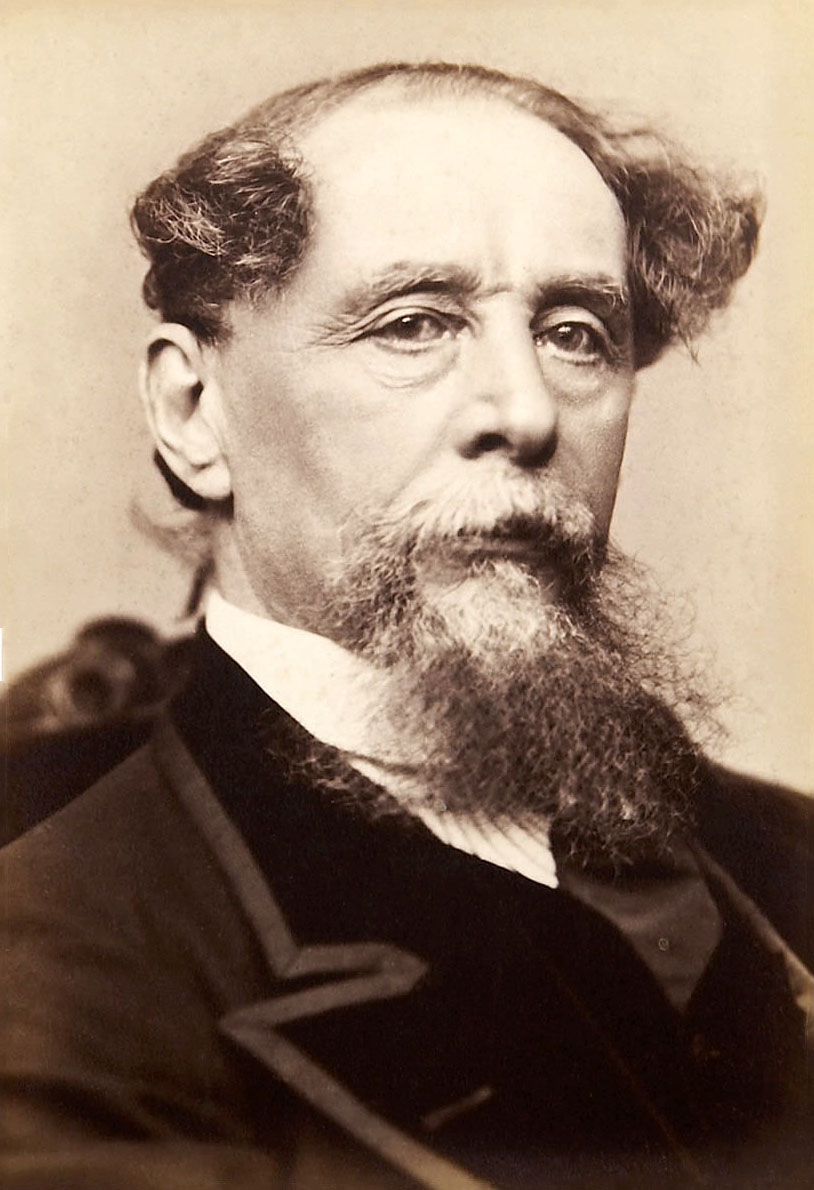
Charles Dickens has been in the news a lot recently. With his bicentenary in 2012, events and celebrations are being announced with increasing frequency (such as a BFI film festival and Dickens-inspired  schedule at the BBC).

One story that caught my eye in particular was the preservation work being carried out on a screen divider decorated by Dickens and William Macready in the 1850s.

Pasted over with pictures cut from prints and periodicals, this decoupage screen offers a composite snapshot of nineteenth-century politics, as well as historical, literary and scientific cultures: Lord Nelson, The Duke of Wellington, Napoleon, Henry VIII, several Shakespearean scenes, William Blake, Lord Byron, Isaac Newton, etc.

Charles Dickens' and William Macready's screen
Source: Daily Mail
The screen has been donated by Macready’s descendants to Sherborne House, Macready’s home in Dorset. Speaking in the Daily Mail, John Sunderland-Smith (chairman of the Friends of Sherborne House) described the screen as an educational device: ‘The pictures include the names of the day as well as Shakespeare and classical history -- things Macready would want his children to know’ [1]. As such, the act of decoupage, of cutting and pasting together, is read in terms of its ability to preserve and narrate. Each disparate image recalls an individual or event (someone or something deemed worthy of a place on the screen), but they combine to tell a broader story -- a distinctly national story, a snapshot of this sceptred isle, what the Daily Mail has called the ‘who’s who of Victorian England’.

Dickens’ and Macready’s screen is not the only one of its kind. Decoupage was a popular Victorian leisure activity, although one more commonly associated with feminine handicrafts. Jane Welsh Carlyle, wife of Thomas Carlyle, decorated a similar screen in the late 1840s. The afterlife of this screen sheds a different light on the material objects’ relation to narrative and history.

Jane Welsh Carlyle's screen
Source: National Trust
After her death in 1866, Carlyle prepared an edition of Jane’s letters. On reaching a description of her screen, he offered the following comment: ‘Stands here to this day, the beautifullest and cleverest screen I have ever seen. How strange, how mournfully affecting to me now’ [2]. Here the screen is a tangible memorial; it embodies the same virtues -- the same cleverness and beauty -- that Carlyle mourns in his dead wife. He bequeathed the screen to Jane’s niece, Mary Aitken, for she ‘[knew] by whom it was made’ and understood ‘the value I have always put upon it, and will take best care of it to the end of her life’ [3]. Thus, in seeking to preserve the screen, Carlyle seeks to keep the memory of its creator alive.

Dickens’ screen has now become part of this biographical discourse -- his screen (and his personality invariably eclipses the input of Macready) is a relic, part of the physical record of his life and something to be visited and admired. Jane Welsh Carlyle’s screen remains on display at Carlyle’s House, 5 (now no. 24) Cheyne Row, and work is under way to identify her pasted images. Both offer an insight into the life narratives that emerge from, and are constructed by, material objects -- human interactions with objects, and the crafting and shaping of objects, become a form of storytelling.

But these stories are never neutral. For example, the two screens produce differently gendered narratives: Dickens and public, national history; Jane Welsh Carlyle and private, familial memory (despite the equally public, equally historical nature of her selected images). I’ll end, therefore, with some questions. How do we read objects, or the manipulation of material things, in the lives of auto/biographical subjects? Do we use them to support or challenge pre-existing life scripts? (In the case of Jane Welsh Carlyle, decoupage as a domestic, feminine handicraft. In the case of Dickens,  decoupage as a masculine engagement with public, national histories.)

A forthcoming conference at the new Oxford Centre for Life-Writing on the ‘Lives of Objects’ (September 2013) will provide the perfect arena to investigate further.

[1] ‘The who's who of Victorian England pasted on to a 7ft divider by Charles Dickens to educate an actor friend's children’, Daily Mail, 24 October 2011, www.dailymail.co.uk/news/article-2052772/Screen-Charles-Dickens-Victorian-society-undergoes-restoration.html

[2] Letters and Memorials of Jane Welsh Carlyle. Prepared for Publication by Thomas Carlyle, ed. by James Anthony Froude, 3 vols (London: Longmans, Green, 1883), II, p. 38.

[3] Cited in Carlyle’s House (The National Trust, 1979), p. 23.