Showing posts with label fiction. Show all posts

Sunday, April 29, 2012

Nineteenth-Century Memory: On Biography, Forgetfulness and Not Knowing

Sundial, St Peter's Church, Norton Disney
Photograph by J. Hannan-Briggs
Used under the Creative Commons License
In March this year I attended a conference at Leeds Trinity University College on the theme of Nineteenth-Century Memory: Approaches and Appropriations. Papers ranged broadly, from Victorian accounts of the recent past to NeoVictorian re-imaginings, from trauma and melancholy to tropes of time passing.

Of particular interest to me were papers on the subject of memory and life narrative, including Jo Taylor (Keele) on the posthumous reputation of Samuel Taylor Coleridge as shaped by the editorship of his children, Sara and Hartley, and Hana Leaper (Liverpool) who traced the influence of Leslie Stephen’s Mausoleum Book on the work of Virginia Woolf and Vanessa Bell. And it was Victorian biography -- a much-maligned genre -- that provided the subject matter for Trev Lynn Broughton’s (York) opening keynote on the topic of remembering and forgetting.

Broughton challenged the notion that remembering and forgetting are opposite terms. To forget something, she argued, was not simply a case of failing to remember. Turning to biography, so often seen (in its Victorian manifestation) as a ‘site and sign of repression’, a literary form in thrall to censorship and reticence, forgetfulness can be read as a creative act. In organising a life into a coherent narrative, biography is necessarily selective; it chooses what memories to transmit to a new generation of readers, and it chooses what elements to pass over, to omit or obscure. For Broughton, therefore, biographies are both a ‘memorial’ and a ‘site of burial’ -- in remembering their  subject, they demonstrate the importance of forgetting.

The endlessly re-tellable nature of life narratives supports this reading of biography as a product of forgetfulness. With each new version of a life -- with each new claim to have written the “definitive” account -- different elements are remembered and forgotten, different memories are uncovered and buried. But is it ever possible (or desirable) to remember and memorialise a life both entire and complete? Alongside remembering and forgetting, should we consider the problem of not knowing?

In 1927, E.M. Forster delivered the Clarke Lectures at Trinity College, Cambridge, published later that year under the title Aspects of the Novel. In these lectures Forster drew a distinction between ‘Homo Fictus’, the species of human living in fiction, and ‘Homo Sapiens’, the species of human living in history [1]. What separates these different classes of being is their un/knowability:

In daily life we never understand each other, neither complete clairvoyance nor complete confessional exists. But people in a novel can be understood completely by the reader, if the novelist wishes; their inner as well as their outer life can be exposed. We cannot understand each other, except in a rough and ready way; we cannot reveal ourselves, even when we want to; what we call intimacy is only makeshift; perfect knowledge is an illusion. But in the novel we can know people perfectly. [2]

It is beyond the scope of this blog post to debate Forster’s claims for status of characters in fiction, but his account of the unknowability of ‘Homo Sapiens’ helps shed a light on the vitality of remembering and forgetting in life-writing. If our knowledge of a biographical subject is ‘illusive’, then remembering and forgetting are the means by which we construct this illusion. In remembering certain elements and forgetting others, we cover and smooth the gaps and fractures -- we can thus stake a (false) claim to the “definitive” life. And yet, it is the unknowable nature of ‘Homo Sapiens’ -- the very impossibility of ‘clairvoyance’ or ‘complete confessional’ -- that empowers the biographer to remember and forget, which guarantees the re-telling, the re-writing, the re-membering of a life narrative.


[1] E.M. Forster [1927], Aspects of the Novel (London: Edward Arnold, 1945), p. 78.
[2] Forster, Aspects of the Novel, pp. 67-8.

Tuesday, October 25, 2011

Allusive Biography: The Life of Charlotte Brontë

Haworth Parsonage, 1860s.
Source: Mick's Pad
I’ve just finished re-reading Elizabeth Gaskell’s 1857 biography, The Life of Charlotte Brontë. The book caused widespread controversy on its first publication; lawsuits were threatened and readers were scandalised by Gaskell’s ventures behind closed doors, her attempts to reveal the private and ‘proper’ woman behind the famous writer. The Life of Charlotte Brontë certainly gives the lie to Victorian biography’s poor reputation for dryness and needless verbosity.

I first read Gaskell’s biography while researching and writing my doctoral thesis. As I re-read the work, I was struck again by a startling and allusive moment. Early in the biography Gaskell describes the  remarkable habit of the three Brontë sisters, pacing up and down the parsonage sitting-room, sharing their ideas for writing, discussing their works in progress and ‘making out’ their plots. After the deaths of Emily and Anne, Charlotte continues this ritual alone:

Three sisters had done this,—then two, the other sister dropping off from the walk,—and now one was left desolate to listen for echoing steps that never came,—and to hear the wind sobbing at the windows, with an almost articulate sound. (381)

All the grim superstitions of the North had been implanted in [Charlotte Brontë] during her childhood by the servants, who believed in them. They recurred to her now,—with no shrinking from the spirits of the Dead, but with such an intense longing once more to stand face to face with the souls of her sisters, as no one could have felt. It seemed as if the very strength of her yearning should have compelled them to appear. On windy nights, cries, and sobs, and wailings seemed to go round the house, as of the dearly-beloved striving to force their way to her. (401) 
Elizabeth Gaskell, The Life of Charlotte Brontë, ed. by Alan Shelston (London: Penguin, 1985)

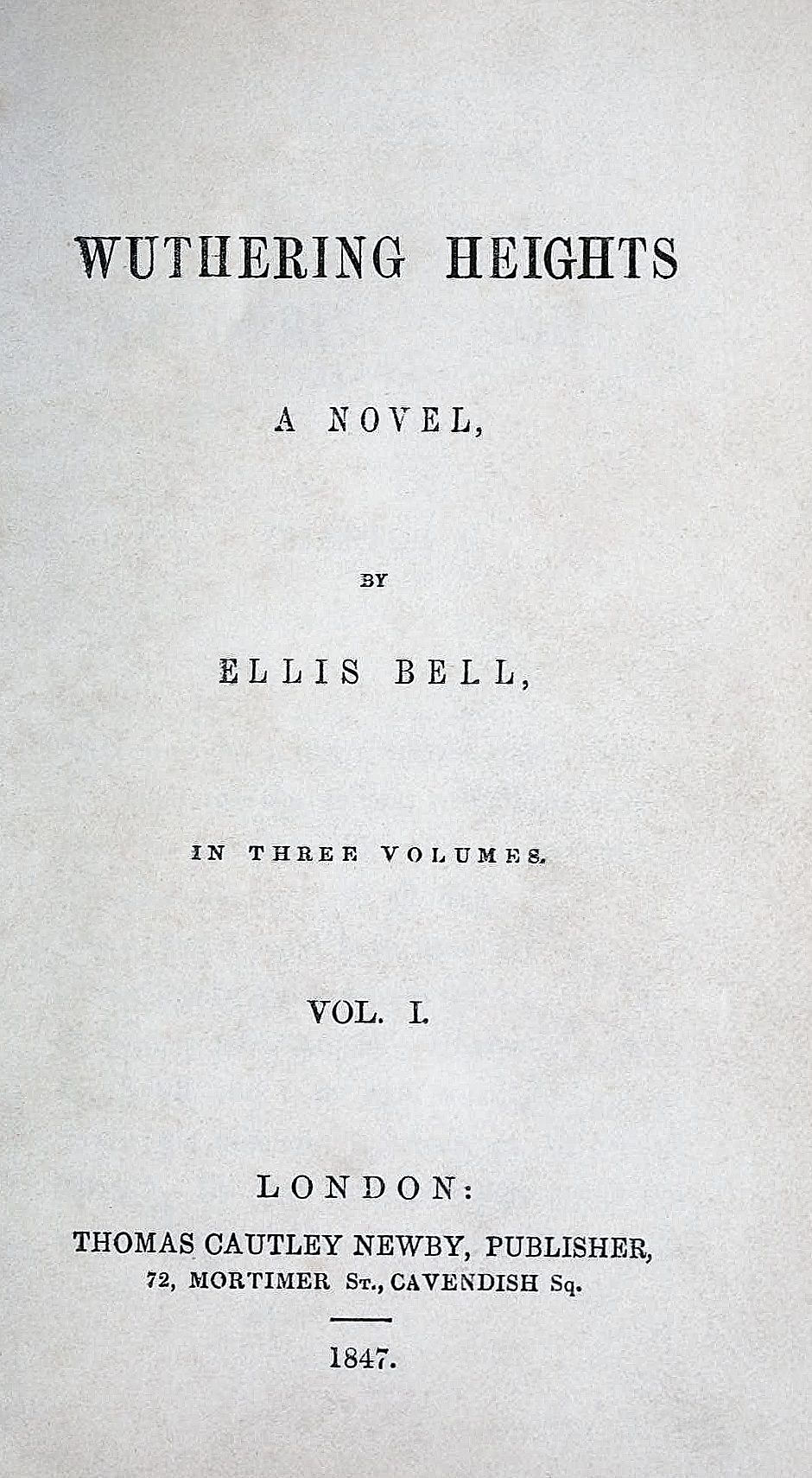
Wuthering Heights, 1847
Source: Wikipedia
The tone of these passages may surprise you—this is biography, remember, not fiction. But Gaskell’s biography is as lyrical and dramatic as any novel, and the more seasoned Brontë readers among you may well have been struck by something familiar.

Do you remember Lockwood’s dream from the opening section of Emily Brontë’s Wuthering Heights? Do you remember Heathcliff’s reaction to this dream?

I was lying in the oak closet, and I heard distinctly the gusty wind, and the driving of the snow; I heard, also, the fir bough repeat its teasing sound, and ascribed it to the right cause: but it annoyed me so much, that I resolved to silence it, if possible; and, I thought, I rose and endeavoured to unhasp the casement. The hook was soldered into the staple: a circumstance observed by me when awake, but forgotten. ‘I must stop it, nevertheless!’ I muttered, knocking my knuckles through the glass, and stretching an arm out to seize the importunate branch; instead of which, my fingers closed on the fingers of a little, ice-cold hand! The intense horror of nightmare came over me: I tried to draw back my arm, but the hand clung to it, and a most melancholy voice sobbed, ‘Let me in—let me in!’ ‘Who are you?’ I asked, struggling, meanwhile, to disengage myself. ‘Catherine Linton,’ it replied, shiveringly […] ‘I’m come home: I’d lost my way on the moor!’ (20) 

[Heathcliff] got on to the bed, and wrenched open the lattice, bursting, as he pulled at it, into an uncontrollable passion of tears. ‘Come in! come in!’ he sobbed. ‘Cathy, do come. Oh, do—once more! Oh! my heart’s darling! hear me this time—Catherine, at last!’ The spectre showed a spectre’s ordinary caprice: it gave no sign of being; but the snow and wind whirled wildly through, even reaching my station, and blowing out the light. (24) 
Emily Bronte, Wuthering Heights, ed. by Ian Jack (Oxford: Oxford University Press, 2009)

Gaskell transforms Charlotte Brontë’s act of pacing—and thus her continued attempts to write—into a ghostly haunting, employing a direct and explicit (yet unnamed, unspoken) allusion to her dead sister’s only novel. Thus she blurs the dividing line between life narrative and fiction. The biography appropriates the energy and fantasy of Emily’s novel, and strange moments like this punctuate Gaskell’s text. They typically deal with Brontë as a writer, whereas realist narratives are used to depict Brontë as a ‘proper’ woman. Here, therefore, the ghostly allusion to Wuthering Heights serves to displace Brontë’s act of writing, making it somehow ‘unreal’, strange and supernatural.

The allusiveness of Gaskell’s biography, its use and borrowing from a range of texts (declared or otherwise), reveals the permeable nature of genres and the artificiality of separate traditions where fiction and non-fiction are rendered asunder.

Saturday, October 22, 2011

Holy Flying Circus

Holy Flying Circus, broadcast on BBC Four earlier this week (19.10.11), contained all the classic ingredients of TV biopic.

The cast of Holy Flying Circus (left to right): Steve Punt as Eric Idle,
Phil Nichol as Terry Gilliam, Charles Edwards as Michael Palin,
Tom Fisher as Graham Chapman; Darren Boyd as John Cleese,
and Rufus Jones as Terry Jones.
Source: www.creativereview.co.uk
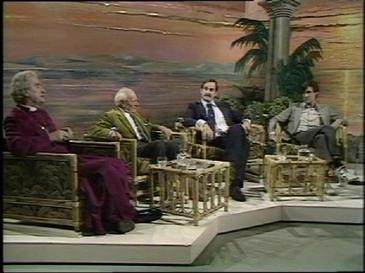
First of all, the plot was grounded in a recognisable history: that of Monty Python as comic phenomenon, and debates in the 1970s over social permissiveness and TV censorship. It re-told the story of Python’s Life of Brian, the controversy it sparked even before its release in cinemas, and the attempted defence of the film by John Cleese and Michael Palin on the BBC chat show Friday Night, Saturday Morning. Thus far, we remain safely in biopic territory.

The show’s casting and character performances made for an uncanny viewing experience. Close physical likenesses aside (and these were particularly striking, just look at Steve Punt as Eric Idle!), a broader attempt for accuracy was being made. In the Friday Night, Saturday Morning sequence, Charles Edwards and Darren Boyd, playing Michael Palin and John Cleese respectively, both re-enacted, with an accuracy we now associate with Michael Sheen (in films such as Frost/Nixon), the Pythons’ behaviours and utterances. In the slot immediately following Holy Flying Circus, BBC Four broadcast the original interview. Viewers who stayed up to watch both programmes could see that the drama not only reproduced original dialogue, but had reconstructed the multi-coloured, multi-foliaged Friday Night, Saturday Morning set. This pairing invited comparisons between ‘original’ and ‘copy’; it seemed to demonstrate a confidence in the drama’s accuracy, reinforcing its links to actual events.

Cleese and Palin on Friday Night, Saturday Morning (1979).
Source: Wikipedia
Biopic, then. A genre -- to adapt George Custen’s definition -- that depicts the lives of historical persons; a genre comparable to literary biography and sharing in its problematic claims to “truth, accuracy and interpretation”. But Holy Flying Circus was something more, something different. Indeed, it demonstrated a keen awareness that truth and accuracy are problematic -- that any claim to represent ‘real life’ should be treated as suspect. And anyone, I am sure, who saw the programme will realise that something fundamental is missing from my description above.

A biopic, yes. But a delightfully, self-consciously Pythonesque biopic. Fantasy sequences erupt into -- and disrupt -- the programme’s nominally factual narrative. Described by the BBC as a “re-imagining” of events, Holy Flying Circus employed Gilliam-inspired animation, a puppetry fight sequence between Palin and Cleese (complete with Star Wars light sabre), an Inception­-like sequence of multi-layered nightmare, Stephen Fry as God, and a whole range of self-conscious anachronisms. It was also richly intertextual, referencing many famous Python gags. Rufus Jones played Terry Jones, but also Terry Jones in character as Michael Palin’s wife, cue a manly walk and occasional gruff voice, reminiscent of Mandy (mother of Brian) and the falsely-bearded women who surreptitiously attend a stoning. Standing-in for Mary Whitehouse’s ‘Festival of Light’ pressure group are The Popular People’s Church of St. Sophia, formerly The People’s Church of St. Sophia, formerly The St. Sophian People’s Church. And these are just two of the many, many allusions that Python fans will enjoy, and which serve to distance Holy Flying Circus from traditional biopic. Their inclusion, it might be argued, offers a parallel biographical strand, one concerned with Python’s humour, style, and ethos, thus extending the reach of the programme beyond the immediate events of 1979. But these references also signify performance and the (re)construction of events; they highlight (and make a virtue of) the impossibility of holding a mirror to the past.


But as a life-writing researcher, it was the portrayal of John Cleese that interested me most. In one of the many interrupting sequences, a “Party Political Broadcast by John Cleese on behalf of John Cleese” made it clear that the subject we saw on screen was “based loosely” on the “Basil Fawlty persona”. For me, this moment encapsulated the programme’s complex play with life narrative and representation. We expect -- to return again to George Custen -- that biopic is concerned with historical persons, but here this is undermined by a self-conscious disavowal. We are watching ‘Boyd as Cleese as Fawlty’, not Boyd as the historical Cleese. What makes this more intriguing is the suggestion, writ large, that Cleese has become inseparable from Fawlty in our popular consciousness. Thus, life narratives are shown to create and reinforce ‘character’ rather than reveal a pre-existing and referential subject. Where the Friday Night, Saturday Morning sequence signalled accurate reconstruction, here the necessarily fictive quality of biopic is revealed.

I will end, however, where Holy Flying Circus began. In the programme's opening sequence, Ben Crispin as Jesus addresses the camera: he asserts that most of what we are about to see is “largely made up… like the Bible”. Without daring to open this theological can of worms, I’ll simply suggest this statement resonates in terms of genre and that Holy Flying Circus has much to tell us about the creativity of life narrative and biopic.