Showing posts with label biography. Show all posts

Wednesday, June 6, 2012

Book Chapter: Contradictory Woolf

Just a quick post to announce the publication of my book chapter on Virginia Woolf’s Roger Fry (1940), the Omega Workshops and her contradictory theorising of biography:

‘"But something betwixt and between": Roger Fry and the contradictions of biography’, in Contradictory Woolf, ed. by Derek Ryan and Stella Bolaki (Clemson: Clemson University Digital Press, 2012), pp. 82-7

This chapter forms part of an edited collection emerging from the 21st Annual International Conference on Virginia Woolf, held at the University of Glasgow in June 2011. Print copies are available to order, but I’m very happy to see the online version is open access. [The series back catalogue is also available online, and I have a chapter on Orlando (1928) and the ‘limits’ of biographical representation in Woolfian Boundaries (2007).]

Although the paper evolved during the writing process, becoming increasingly concerned with the relationship between Woolf's theories of biography and Fry's theories of art and craft, I thought I would whet your appetite with a glimpse of my original abstract:
"But something betwixt and between": Roger Fry and the contradictions of biography
He chooses; he synthesises; in short, he has ceased to be the chronicler; he has become an artist. (‘The New Biography’, 1927)
And thus we come to the conclusion, that he is a craftsman, not an artist; and his work is not a work of art, but something betwixt and between. (‘The Art of Biography’, 1939) 
Virginia Woolf’s Roger Fry (1940) remains the black sheep of the Woolfian canon. No critical edition is currently in print. It is conspicuously absent from the Penguin and Oxford ‘Classics’ lists, and though Vintage reproduces the text as part of its ‘Lives’ series, there is no scholarly introduction or editorial apparatus. It seems that Roger (to appropriate Woolf’s nickname for the work) has a bad reputation. This is due, in large part, to Woolf’s own response. In her diaries and letters, Roger becomes ‘donkey work & […] sober drudgery’, or nothing more than ‘a piece of cabinet making’. But it is the connection between Roger and ‘The Art of Biography’ that strikes the fatal blow.
This paper will explore Woolf’s contradictory theorising of biography, from the optimism of ‘The New Biography’ to the seeming retractions of ‘The Art of Biography’. Woolf bestows and then strips biography of its claim to art, with the result that Roger (contemporaneous with ‘The Art of Biography’) has been read as an embodiment of its conservative aesthetic. I will argue, however, that Woolf’s later writing on biography, far from enacting a volte face, serves to develop and adapt her earlier position. As such, I will offer a reassessment of Roger, using its method and practice to demonstrate an ongoing Woolfian experiment. In Roger, as in her earlier biographical works, Woolf exploits the productiveness of paradox and contradiction—that ‘something betwixt and between’ at the heart of ‘The Art of Biography’.

Sunday, April 29, 2012

Nineteenth-Century Memory: On Biography, Forgetfulness and Not Knowing

Sundial, St Peter's Church, Norton Disney
Photograph by J. Hannan-Briggs
Used under the Creative Commons License
In March this year I attended a conference at Leeds Trinity University College on the theme of Nineteenth-Century Memory: Approaches and Appropriations. Papers ranged broadly, from Victorian accounts of the recent past to NeoVictorian re-imaginings, from trauma and melancholy to tropes of time passing.

Of particular interest to me were papers on the subject of memory and life narrative, including Jo Taylor (Keele) on the posthumous reputation of Samuel Taylor Coleridge as shaped by the editorship of his children, Sara and Hartley, and Hana Leaper (Liverpool) who traced the influence of Leslie Stephen’s Mausoleum Book on the work of Virginia Woolf and Vanessa Bell. And it was Victorian biography -- a much-maligned genre -- that provided the subject matter for Trev Lynn Broughton’s (York) opening keynote on the topic of remembering and forgetting.

Broughton challenged the notion that remembering and forgetting are opposite terms. To forget something, she argued, was not simply a case of failing to remember. Turning to biography, so often seen (in its Victorian manifestation) as a ‘site and sign of repression’, a literary form in thrall to censorship and reticence, forgetfulness can be read as a creative act. In organising a life into a coherent narrative, biography is necessarily selective; it chooses what memories to transmit to a new generation of readers, and it chooses what elements to pass over, to omit or obscure. For Broughton, therefore, biographies are both a ‘memorial’ and a ‘site of burial’ -- in remembering their  subject, they demonstrate the importance of forgetting.

The endlessly re-tellable nature of life narratives supports this reading of biography as a product of forgetfulness. With each new version of a life -- with each new claim to have written the “definitive” account -- different elements are remembered and forgotten, different memories are uncovered and buried. But is it ever possible (or desirable) to remember and memorialise a life both entire and complete? Alongside remembering and forgetting, should we consider the problem of not knowing?

In 1927, E.M. Forster delivered the Clarke Lectures at Trinity College, Cambridge, published later that year under the title Aspects of the Novel. In these lectures Forster drew a distinction between ‘Homo Fictus’, the species of human living in fiction, and ‘Homo Sapiens’, the species of human living in history [1]. What separates these different classes of being is their un/knowability:

In daily life we never understand each other, neither complete clairvoyance nor complete confessional exists. But people in a novel can be understood completely by the reader, if the novelist wishes; their inner as well as their outer life can be exposed. We cannot understand each other, except in a rough and ready way; we cannot reveal ourselves, even when we want to; what we call intimacy is only makeshift; perfect knowledge is an illusion. But in the novel we can know people perfectly. [2]

It is beyond the scope of this blog post to debate Forster’s claims for status of characters in fiction, but his account of the unknowability of ‘Homo Sapiens’ helps shed a light on the vitality of remembering and forgetting in life-writing. If our knowledge of a biographical subject is ‘illusive’, then remembering and forgetting are the means by which we construct this illusion. In remembering certain elements and forgetting others, we cover and smooth the gaps and fractures -- we can thus stake a (false) claim to the “definitive” life. And yet, it is the unknowable nature of ‘Homo Sapiens’ -- the very impossibility of ‘clairvoyance’ or ‘complete confessional’ -- that empowers the biographer to remember and forget, which guarantees the re-telling, the re-writing, the re-membering of a life narrative.


[1] E.M. Forster [1927], Aspects of the Novel (London: Edward Arnold, 1945), p. 78.
[2] Forster, Aspects of the Novel, pp. 67-8.

Saturday, April 7, 2012

Review Essay on Victorian Life-Writing (JVC 17.1)

A quick post to announce the publication of my review essay on recent studies of Victorian life-writing in the Journal of Victorian Culture.


Both are ambitious and important studies. They help to redress a long-standing critical tradition that 'jumps over' the nineteenth century when constructing an account of innovation, dismissing the Victorian period as a time of reactionary conservatism in the writing of lives. These works are highly recommended!


Monday, January 30, 2012

Virginia Woolf Birthday Lecture, 28 January 2012

Virginia Woolf (photographed in 1902)
by George Charles Beresford
Source: Wikipedia
Last Saturday I travelled down to London for the annual Virginia Woolf birthday lecture organised by the Virginia Woolf Society of Great Britain. Fittingly, the event was held in the Keynes Library at 43 Gordon Square, complete with Vanessa Bell paintings looking down upon the audience from the rather grand walls. There was birthday cake and champagne, and a fascinating lecture by Michael Whitworth on the topic of ‘Virginia Woolf, Fame and Gloire’.

Whitworth traced the nuances of fame, reputation and ‘afterlives’ as debated and explored in Woolf’s fiction, essays and her correspondence with Logan Pearsall Smith. Ranging from Night and Day to Between the Acts -- and taking in Jacob’s Room, To The Lighthouse and Orlando along the way -- Whitworth teased out the multiple meanings of fame and longevity in Woolf’s work. What is the relationship between the celebrity of an author and the value of a text? Is fame to be measured in terms of money, revenue and sales? Or is it the product of genius and the result of a lasting work of art? And where is the book as physical object in all this? What is the relationship, if any, between the preservation of pages and bindings, and preservation of a writers’ reputation?

An extended version of Whitworth’s lecture will soon be published and available to buy from the VWSGB, and I look forward to getting my hands on a copy. As a life-writing researcher, I was intrigued by the questions raised and Whitworth’s exploration of the relationship between authors (or author figures in fiction) and texts, between authors and books. For Whitworth, Logan Pearsall Smith -- with whom Woolf debated the issue of fame, defending modern writers against accusations of debased chasing after money -- provided the model for Nick Greene in Orlando (revising a critical tradition that would have Edmund Gosse as the template for this character). As readers, we are invited to suspect Nick Greene and his championing of ‘gloire’; he is vulgar, grotesque and his views seem detached from the realities of the writing and book trade, from the vitality of writing as it is practised now, with his head stuck firmly in the past. But the reference to Nick Greene set my mind to thinking about a different aspect of fame, reputation and ‘afterlives’…

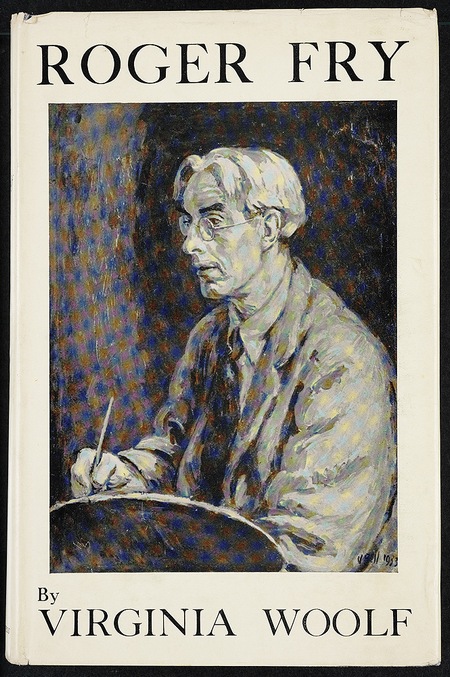
Virginia Woolf, Roger Fry: A Biography (1940)
Source: www.mantex.co.uk
Nick Greene writes a satire of his patron Orlando; as such, the ‘gloire’ of his poem depends on the cannibalised reputation of another. Orlando as a novel is a mock-biography of Vita Sackville-West and much of its humour and playfulness depends on the reputation (and infamy) of its subject. While Woolf was writing Between the Acts and exploring the lastingness -- or rather, the “scraps, orts, and fragments” [1] -- of a work of art, she was also writing her life of Roger Fry, a book that would cause much difficulty in the writing, not least because of the responsibility she felt to friends and family to ‘capture’ Roger, yet also to preserve and protect his reputation. When dealing with his affair with her sister, Vanessa Bell, Woolf exclaimed: “What am I to say about you? […] Do give me some views; how to deal with love so that we’re not all blushing” [2].

In the case of Roger Fry, the fame and reputation of the biographer was intimately tied to, and responsible for, the fame and reputation of the biographical subject. It is striking, therefore, that Roger Fry is the most forgotten, most neglected of Woolf’s major works; it enjoys the least fame and the most doubted, the most questioned reputation. (It is, however, a fascinating biography offering a sensitive and experimental account of Fry’s life -- but this is an argument for another day.)

Literary biography is a pertinent genre for an exploration of fame and longevity: of text, of subject, of biographer. And thus, when the published version of Whitworth’s lecture arrives through my letterbox, I’ll be keen to see how its arguments relate to Woolf’s career-long interest in the writing of lives.

[1] Virginia Woolf, Between the Acts, ed. by Frank Kermode (Oxford: Oxford University Press, 2008), p. 169.

[2] Virginia Woolf to Vanessa Bell, 8 October 1938. Leave The Letters Till We’re Dead. The Letters of Virginia Woolf, Volume Six: 1936-1941, ed. by Nigel Nicolson and Joanne Trautmann (London: The Hogarth Press, 1980, p. 285.

Sunday, December 4, 2011

Objects and Material Things II: Souvenirs and Collecting

Last week I blogged about two very different life-narratives emerging from two very similar items: Victorian decoupage screens -- one created by a man, Charles Dickens, and the other created by a woman, Jane Welsh Carlyle.

In turn, this was cited by Charlotte Mathieson, an early-career researcher at the University of Warwick, in a post exploring literary tourism in the run up to Dickens’s bicentenary in 2012. Mathieson argues for a similar process of storytelling at work in human interactions with place/space. In the case of Dickensian tourism, “[London] is experienced like a material object”: its streets and buildings seem to offer “a physical manifestation” of Dickens’s life and work. Thus, in engaging with the city, the Dickensian tourist seeks an “authentic connection” to author and text. Mathieson is rightly sceptical and she warns against simplistic readings that conflate “real and represented places/spaces”.

Nonetheless, the phenomenon is intriguing and Mathieson’s discussion of tourism puts me in mind of one further category of material object: the souvenir.

The author at Haworth, complete with souvenir tea-towel
Source: Photograph author's own
Souvenirs often depend on life-narratives for their resonance and meaning(s). In turn, their collection and arrangement can produce life-narratives of their own (a form of self-curation on the part of the collector). The rather embarrassing Brontë tea-towel I am clutching in this photo, complete with Haworth parsonage in the background (with modern extension cut out of shot), will serve as an example.

Why did I buy that tea-towel? Putting aside any claims I might make to ironic purchasing -- to a self-conscious seeking out of tacky/kitsch items -- my selection of the tea-towel was first and foremost the result of my interest in the life and works of the Brontë sisters. But you’ll not be surprised to hear that little can be gleaned on either count from the tea-towel itself -- I was already aware of the sisters’ names and the places they inhabited, and the tea-towel told me nothing at all of their works! But I purchased it anyway, and it seems to me the only reason I did so was to take a piece of Haworth away with me: a physical reminder; proof (if proof were ever needed) of my visit and of my own presence in the spaces previously inhabited/experienced by the Brontës.

It is particularly apt, in the light of Mathieson’s post on Dickensian tourism, that the tea-towel is primarily concerned with place. And one can safely assume that the manufacturer is targeting an audience who has visited these places (on some form of Brontë pilgrimage). As souvenir, therefore, it seeks to preserve that interaction with place/space described by Matheison; it becomes the material trace or remnant of that hoped-for “authentic connection” with text and author.

Some souvenirs from the author's collection
Source: Photograph author's own
But surely the tea-towel also says something about me? (And I would ask you to be kind…) Again, you’ll not be surprised to hear that I own several other items of a ‘literary-touristical’ persuasion. I have a mug from Sissinghurst Castle, home of Vita Sackville-West; I have pencils and pens from several writers’ homes now in the possession of the National Trust; I even have a Virginia Woolf fridge magnet.

It’s quite a collection, and one that continues to swell. In their accumulation and combination these objects cease to tell stories about their subject alone, and begin to tell stories about me. In her work on collecting, Susan Pearce views souvenirs as part of “our attempt to make sense of our personal histories”: their collection is thus representative of our efforts “to create an essential personal and social self” [1]. Souvenirs, therefore, are aids to self-fashioning. Tea-towel, mug, pencil, pens and fridge magnet all serve to ‘narrate’ my interest in nineteenth and twentieth-century literature; they help to construct and reinforce my sense of self as a literary critic and book lover.

But, to end with a question, is the self of my souvenir collection any more or less authentic than the engagement with author and text promised by literary tourism, by walking the streets of modern-day London in the footsteps of Dickens and his characters?


[1] Susan M. Pearce, ‘Collecting reconsidered’, in Interpreting Objects and Collections, ed. by Susan M. Pearce (London: Routledge, 1994), pp. 193-204 (p. 196).

Sunday, November 27, 2011

Objects and Material Things I: Reading Screens

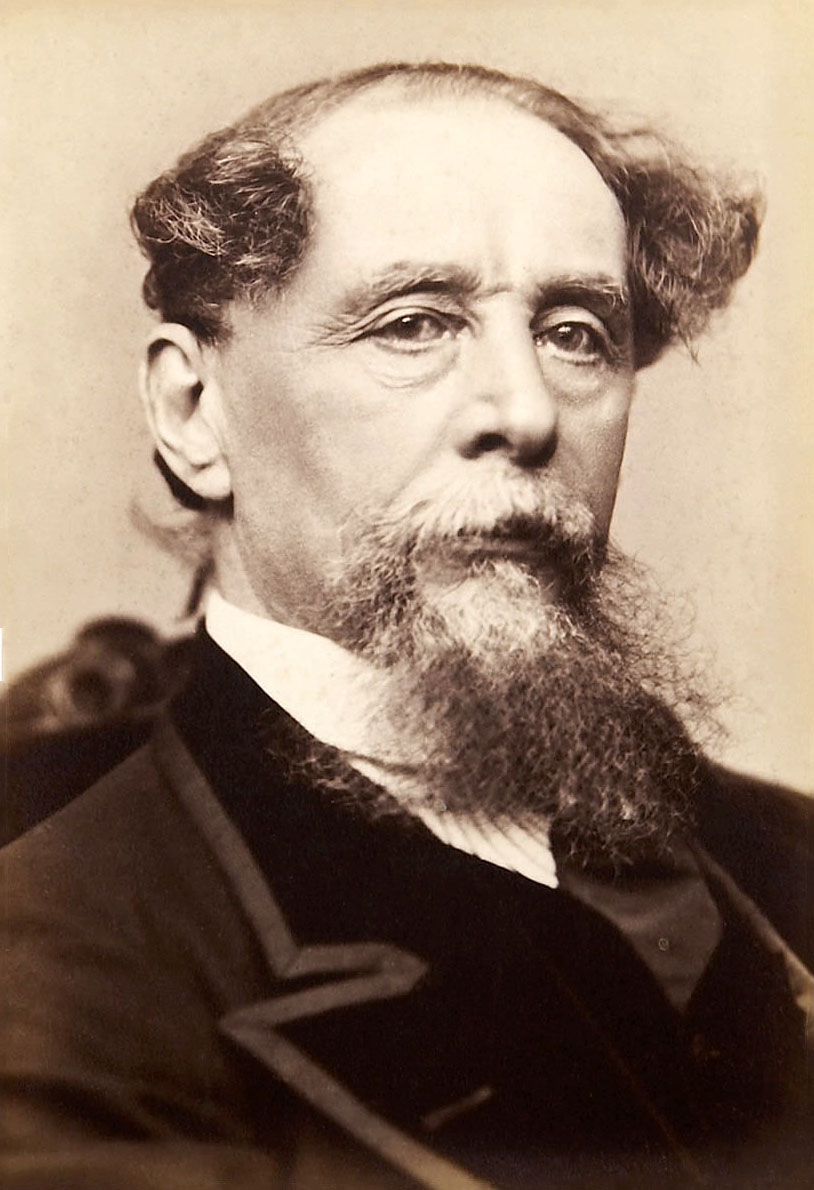
Source: Wikipedia
Charles Dickens has been in the news a lot recently. With his bicentenary in 2012, events and celebrations are being announced with increasing frequency (such as a BFI film festival and Dickens-inspired  schedule at the BBC).

One story that caught my eye in particular was the preservation work being carried out on a screen divider decorated by Dickens and William Macready in the 1850s.

Pasted over with pictures cut from prints and periodicals, this decoupage screen offers a composite snapshot of nineteenth-century politics, as well as historical, literary and scientific cultures: Lord Nelson, The Duke of Wellington, Napoleon, Henry VIII, several Shakespearean scenes, William Blake, Lord Byron, Isaac Newton, etc.

Charles Dickens' and William Macready's screen
Source: Daily Mail
The screen has been donated by Macready’s descendants to Sherborne House, Macready’s home in Dorset. Speaking in the Daily Mail, John Sunderland-Smith (chairman of the Friends of Sherborne House) described the screen as an educational device: ‘The pictures include the names of the day as well as Shakespeare and classical history -- things Macready would want his children to know’ [1]. As such, the act of decoupage, of cutting and pasting together, is read in terms of its ability to preserve and narrate. Each disparate image recalls an individual or event (someone or something deemed worthy of a place on the screen), but they combine to tell a broader story -- a distinctly national story, a snapshot of this sceptred isle, what the Daily Mail has called the ‘who’s who of Victorian England’.

Dickens’ and Macready’s screen is not the only one of its kind. Decoupage was a popular Victorian leisure activity, although one more commonly associated with feminine handicrafts. Jane Welsh Carlyle, wife of Thomas Carlyle, decorated a similar screen in the late 1840s. The afterlife of this screen sheds a different light on the material objects’ relation to narrative and history.

Jane Welsh Carlyle's screen
Source: National Trust
After her death in 1866, Carlyle prepared an edition of Jane’s letters. On reaching a description of her screen, he offered the following comment: ‘Stands here to this day, the beautifullest and cleverest screen I have ever seen. How strange, how mournfully affecting to me now’ [2]. Here the screen is a tangible memorial; it embodies the same virtues -- the same cleverness and beauty -- that Carlyle mourns in his dead wife. He bequeathed the screen to Jane’s niece, Mary Aitken, for she ‘[knew] by whom it was made’ and understood ‘the value I have always put upon it, and will take best care of it to the end of her life’ [3]. Thus, in seeking to preserve the screen, Carlyle seeks to keep the memory of its creator alive.

Dickens’ screen has now become part of this biographical discourse -- his screen (and his personality invariably eclipses the input of Macready) is a relic, part of the physical record of his life and something to be visited and admired. Jane Welsh Carlyle’s screen remains on display at Carlyle’s House, 5 (now no. 24) Cheyne Row, and work is under way to identify her pasted images. Both offer an insight into the life narratives that emerge from, and are constructed by, material objects -- human interactions with objects, and the crafting and shaping of objects, become a form of storytelling.

But these stories are never neutral. For example, the two screens produce differently gendered narratives: Dickens and public, national history; Jane Welsh Carlyle and private, familial memory (despite the equally public, equally historical nature of her selected images). I’ll end, therefore, with some questions. How do we read objects, or the manipulation of material things, in the lives of auto/biographical subjects? Do we use them to support or challenge pre-existing life scripts? (In the case of Jane Welsh Carlyle, decoupage as a domestic, feminine handicraft. In the case of Dickens,  decoupage as a masculine engagement with public, national histories.)

A forthcoming conference at the new Oxford Centre for Life-Writing on the ‘Lives of Objects’ (September 2013) will provide the perfect arena to investigate further.

[1] ‘The who's who of Victorian England pasted on to a 7ft divider by Charles Dickens to educate an actor friend's children’, Daily Mail, 24 October 2011, www.dailymail.co.uk/news/article-2052772/Screen-Charles-Dickens-Victorian-society-undergoes-restoration.html

[2] Letters and Memorials of Jane Welsh Carlyle. Prepared for Publication by Thomas Carlyle, ed. by James Anthony Froude, 3 vols (London: Longmans, Green, 1883), II, p. 38.

[3] Cited in Carlyle’s House (The National Trust, 1979), p. 23.

Monday, October 31, 2011

Crossing Over

Source: Wikipedia
I was particularly struck by an article in this week's Times Higher Education: ‘Through the eyes of others (27 Oct–2 Nov 2011). It asked what the positives and pitfalls are of ‘crossing over’ as a life writer, of writing the life of a differently-gendered subject. Can a woman write the life of a man, and vice versa?

The article’s author, Matthew Reisz, surveyed the opinions of various biographers. Many argued for the neutrality of the biographer-subject relationship. For Frances Spalding, gender should present no obstacle: “the notion that certain subjects should be barred to certain people is abhorrent.” For Miranda Seymour, the biographer must adopt the imaginative stance of the fiction writer and “write about either sex with equal empathy and confidence.”

None of the biographers surveyed came out in favour of gender-limited subject choices -- none argued that women should stick to women, and that men should stick to men. Indeed, the benefits of ‘crossing over’ were vehemently defended. Rather than life-writing seeking to transcend the biases and perspectives of gender, to approach all subjects from a position of neutrality, Jane Ridley celebrated the insights afforded by gender difference. She rejected the notion that biographers must “unsex themselves”. Choosing instead to embrace and exploit the gender divide in her own work, emphasising the lives of women in male-dominated spheres and claiming a privileged, yet decidedly gendered view: “As a woman I am more detached, and I hope that I can combine sympathy with salty scepticism.”

In current life-writing theory, much is made of the relationship between the life of the subject (whether biographical or autobiographical) and the lives of others. Theorists have sought to understand how encounters and interactions with relatives, friends and passing strangers impact upon our self-understanding(s). Recent work has also stressed the relationship between different versions of the same life, between different life narratives in successive biographical texts (and I count myself among this number; you can read my article on the different literary ‘portraits’ of Vita Sackville-West here). But we haven’t fully investigated the relationship between biographer and subject, nor the significance of those threads that connect and separate (such as gender, but also race, ethnicity, sexuality, etc). To what extent does the biographer-subject relationship, real or empathetically imagined, gendered or otherwise, function as a ‘script’ that shapes and forms the resulting narrative?

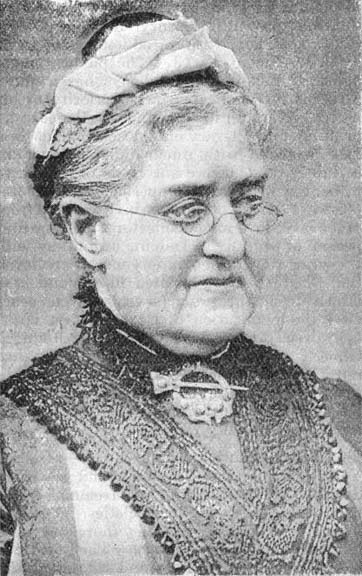
Eliza Lynn Linton
Source: Victorian Web
‘Crossing over’ in life-writing has been something of a hot topic this week. It has also been brought to my attention by the recent arrival through the post of Eliza Lynn Linton’s ‘autobiography in drag’, the gender-bending The Autobiography of Christopher Kirkland (first published in 1885; reissued in 2011 by Victorian Secrets). Though we are unlikely now to be surprised by a nineteenth-century woman writer adopting a male pseudonym, there is something distinctly ‘queer’ about this case.

Linton did not require a male pen-name to facilitate her entrance into the literary public sphere; she was already a well-known writer in her own right, and in her own name. Rather, the shift in gender enables (and mitigates) a rather frank revelation of lesbianism. I’m looking forward to reading this book over the coming weeks, and I’ll be keen to see whether Linton’s “literary transvestism” (as it is described on the back cover) is truly liberating. Will the adoption of a male persona restrict Linton’s narrative in other ways? Will it require a certain performance in terms of plot and gendered speaking posture? I guess I’ll have to get reading…

Tuesday, October 25, 2011

Allusive Biography: The Life of Charlotte Brontë

Haworth Parsonage, 1860s.
Source: Mick's Pad
I’ve just finished re-reading Elizabeth Gaskell’s 1857 biography, The Life of Charlotte Brontë. The book caused widespread controversy on its first publication; lawsuits were threatened and readers were scandalised by Gaskell’s ventures behind closed doors, her attempts to reveal the private and ‘proper’ woman behind the famous writer. The Life of Charlotte Brontë certainly gives the lie to Victorian biography’s poor reputation for dryness and needless verbosity.

I first read Gaskell’s biography while researching and writing my doctoral thesis. As I re-read the work, I was struck again by a startling and allusive moment. Early in the biography Gaskell describes the  remarkable habit of the three Brontë sisters, pacing up and down the parsonage sitting-room, sharing their ideas for writing, discussing their works in progress and ‘making out’ their plots. After the deaths of Emily and Anne, Charlotte continues this ritual alone:

Three sisters had done this,—then two, the other sister dropping off from the walk,—and now one was left desolate to listen for echoing steps that never came,—and to hear the wind sobbing at the windows, with an almost articulate sound. (381)

All the grim superstitions of the North had been implanted in [Charlotte Brontë] during her childhood by the servants, who believed in them. They recurred to her now,—with no shrinking from the spirits of the Dead, but with such an intense longing once more to stand face to face with the souls of her sisters, as no one could have felt. It seemed as if the very strength of her yearning should have compelled them to appear. On windy nights, cries, and sobs, and wailings seemed to go round the house, as of the dearly-beloved striving to force their way to her. (401) 
Elizabeth Gaskell, The Life of Charlotte Brontë, ed. by Alan Shelston (London: Penguin, 1985)

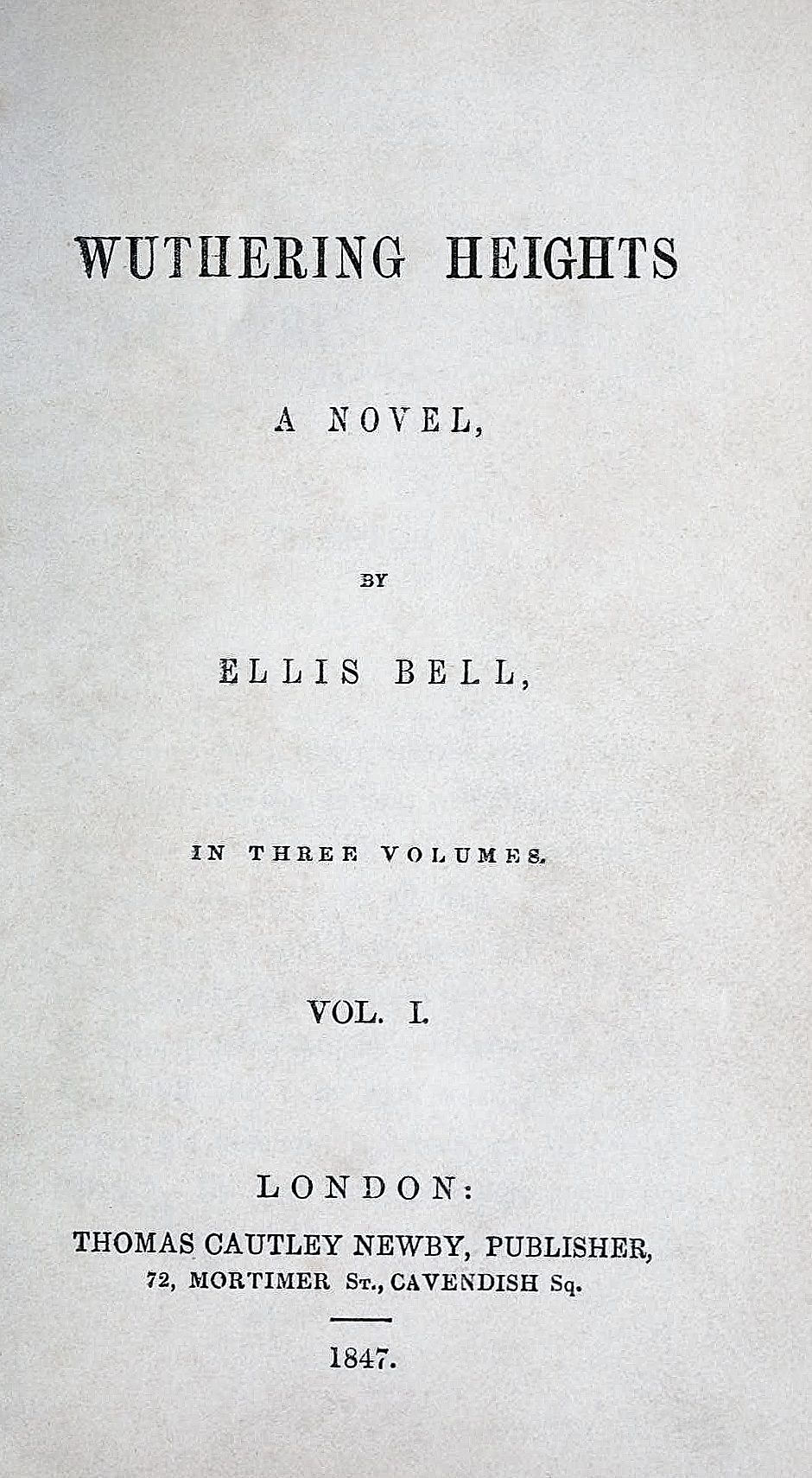
Wuthering Heights, 1847
Source: Wikipedia
The tone of these passages may surprise you—this is biography, remember, not fiction. But Gaskell’s biography is as lyrical and dramatic as any novel, and the more seasoned Brontë readers among you may well have been struck by something familiar.

Do you remember Lockwood’s dream from the opening section of Emily Brontë’s Wuthering Heights? Do you remember Heathcliff’s reaction to this dream?

I was lying in the oak closet, and I heard distinctly the gusty wind, and the driving of the snow; I heard, also, the fir bough repeat its teasing sound, and ascribed it to the right cause: but it annoyed me so much, that I resolved to silence it, if possible; and, I thought, I rose and endeavoured to unhasp the casement. The hook was soldered into the staple: a circumstance observed by me when awake, but forgotten. ‘I must stop it, nevertheless!’ I muttered, knocking my knuckles through the glass, and stretching an arm out to seize the importunate branch; instead of which, my fingers closed on the fingers of a little, ice-cold hand! The intense horror of nightmare came over me: I tried to draw back my arm, but the hand clung to it, and a most melancholy voice sobbed, ‘Let me in—let me in!’ ‘Who are you?’ I asked, struggling, meanwhile, to disengage myself. ‘Catherine Linton,’ it replied, shiveringly […] ‘I’m come home: I’d lost my way on the moor!’ (20) 

[Heathcliff] got on to the bed, and wrenched open the lattice, bursting, as he pulled at it, into an uncontrollable passion of tears. ‘Come in! come in!’ he sobbed. ‘Cathy, do come. Oh, do—once more! Oh! my heart’s darling! hear me this time—Catherine, at last!’ The spectre showed a spectre’s ordinary caprice: it gave no sign of being; but the snow and wind whirled wildly through, even reaching my station, and blowing out the light. (24) 
Emily Bronte, Wuthering Heights, ed. by Ian Jack (Oxford: Oxford University Press, 2009)

Gaskell transforms Charlotte Brontë’s act of pacing—and thus her continued attempts to write—into a ghostly haunting, employing a direct and explicit (yet unnamed, unspoken) allusion to her dead sister’s only novel. Thus she blurs the dividing line between life narrative and fiction. The biography appropriates the energy and fantasy of Emily’s novel, and strange moments like this punctuate Gaskell’s text. They typically deal with Brontë as a writer, whereas realist narratives are used to depict Brontë as a ‘proper’ woman. Here, therefore, the ghostly allusion to Wuthering Heights serves to displace Brontë’s act of writing, making it somehow ‘unreal’, strange and supernatural.

The allusiveness of Gaskell’s biography, its use and borrowing from a range of texts (declared or otherwise), reveals the permeable nature of genres and the artificiality of separate traditions where fiction and non-fiction are rendered asunder.