Showing posts with label biopic. Show all posts

Friday, November 18, 2011

Life Narratives in the News

Source: Flickr (Creative Commons)
Lots of life narrative stories have caught my eye in the past week…

Offering some useful reflections on nonfiction (and 'creative nonfiction') and its relation to constructed selves/identities, Fassler reviews Jonathan Lethem’s new collection of essays, The Ecstasy of Influence (Doubleday, 2011) and conducts an author interview. Fassler traces the book’s attempt to ‘unpack the authorial “I”’—those ‘alternative selves’ selected and adopted by nonfiction writers: ‘[Lethem] sits across from the public version of himself, and watches as his influences surface and his previous incarnations flit across his face.’

Britain In A Day, 12 November 2011
I blogged about this project (and its ‘parent’ project, Life In A Day) last week. Timed to coincide with the event, the Radio Times commissioned a ‘typical Saturday’ diary from Sir Terry Pratchett. Filming is complete, and now the selection, editing and post-production begins. Britain In A Day will be in cinemas and on our TV screens next year.

Wolfson College, Oxford, launched its new Research Cluster—The Oxford Centre for Life-Writing—on 16 November with an inaugural lecture by Prof Michael Wood titled ‘All About his Mother: Reading Proust’s Letters’ (podcast also available). The Centre looks set to be an active and exciting hub for life-writing research understood in its broadest sense. Keep your eyes on their events and study opportunities!

Richard Norton-Taylor, ‘Mackenzie memoirs banned for spilling spy secrets to be republished’, The Guardian, 18 November 2011
An unexpurgated edition of Compton Mackenzie’s war memoir, Greek Memories, will be published next month by Biteback Books. Norton-Taylor explores the furore surrounding its first appearance in 1932 and its subsequent supression by MI5 and MI6 due to the revelation of intelligence secrets (such as the ‘C’ codename for the head of MI6). Autobiography and memoir can be dangerous genres…

This Our Still Life (dir. by Andrew Kötting), 18 November 2011
Collagistic documentary, filmed over twenty years, following the life of director Andrew Kötting and his daughter, Eden, who was born with a rare genetic disorder. An intimate portrait of this father and daughter’s life together, focused in particular on the still-life painting performed by Eden. See Peter Bradshaw’s review in The Guardian.

‘Authors breathe new life into forgotten portraits’, thisislondon.co.uk, 18 November 2011
Portraiture meets imagined life narrative at the NPG between December 2011 and June 2012. Contemporary authors—including Julian Fellowes and Terry Pratchett—have imagined lives and identities to accompany fourteen Tudor portraits. Tracy Chevalier’s contribution sounds particularly intriguing. She ‘queers’ the public art gallery; behind the portrait of ‘a blushing young man’, she imagines the life of ‘an object of homosexual desire’. You can read Alexander McCall Smith's story of 'Mary Peebles' in The Guardian, her life created to accompany a portrait once thought to depict Mary Queen of Scots.

Saturday, October 22, 2011

Holy Flying Circus

Holy Flying Circus, broadcast on BBC Four earlier this week (19.10.11), contained all the classic ingredients of TV biopic.

The cast of Holy Flying Circus (left to right): Steve Punt as Eric Idle,
Phil Nichol as Terry Gilliam, Charles Edwards as Michael Palin,
Tom Fisher as Graham Chapman; Darren Boyd as John Cleese,
and Rufus Jones as Terry Jones.
Source: www.creativereview.co.uk
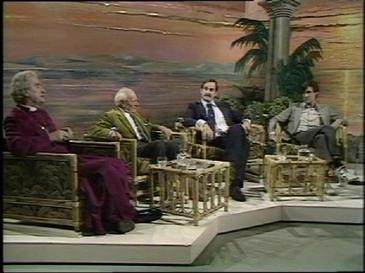
First of all, the plot was grounded in a recognisable history: that of Monty Python as comic phenomenon, and debates in the 1970s over social permissiveness and TV censorship. It re-told the story of Python’s Life of Brian, the controversy it sparked even before its release in cinemas, and the attempted defence of the film by John Cleese and Michael Palin on the BBC chat show Friday Night, Saturday Morning. Thus far, we remain safely in biopic territory.

The show’s casting and character performances made for an uncanny viewing experience. Close physical likenesses aside (and these were particularly striking, just look at Steve Punt as Eric Idle!), a broader attempt for accuracy was being made. In the Friday Night, Saturday Morning sequence, Charles Edwards and Darren Boyd, playing Michael Palin and John Cleese respectively, both re-enacted, with an accuracy we now associate with Michael Sheen (in films such as Frost/Nixon), the Pythons’ behaviours and utterances. In the slot immediately following Holy Flying Circus, BBC Four broadcast the original interview. Viewers who stayed up to watch both programmes could see that the drama not only reproduced original dialogue, but had reconstructed the multi-coloured, multi-foliaged Friday Night, Saturday Morning set. This pairing invited comparisons between ‘original’ and ‘copy’; it seemed to demonstrate a confidence in the drama’s accuracy, reinforcing its links to actual events.

Cleese and Palin on Friday Night, Saturday Morning (1979).
Source: Wikipedia
Biopic, then. A genre -- to adapt George Custen’s definition -- that depicts the lives of historical persons; a genre comparable to literary biography and sharing in its problematic claims to “truth, accuracy and interpretation”. But Holy Flying Circus was something more, something different. Indeed, it demonstrated a keen awareness that truth and accuracy are problematic -- that any claim to represent ‘real life’ should be treated as suspect. And anyone, I am sure, who saw the programme will realise that something fundamental is missing from my description above.

A biopic, yes. But a delightfully, self-consciously Pythonesque biopic. Fantasy sequences erupt into -- and disrupt -- the programme’s nominally factual narrative. Described by the BBC as a “re-imagining” of events, Holy Flying Circus employed Gilliam-inspired animation, a puppetry fight sequence between Palin and Cleese (complete with Star Wars light sabre), an Inception­-like sequence of multi-layered nightmare, Stephen Fry as God, and a whole range of self-conscious anachronisms. It was also richly intertextual, referencing many famous Python gags. Rufus Jones played Terry Jones, but also Terry Jones in character as Michael Palin’s wife, cue a manly walk and occasional gruff voice, reminiscent of Mandy (mother of Brian) and the falsely-bearded women who surreptitiously attend a stoning. Standing-in for Mary Whitehouse’s ‘Festival of Light’ pressure group are The Popular People’s Church of St. Sophia, formerly The People’s Church of St. Sophia, formerly The St. Sophian People’s Church. And these are just two of the many, many allusions that Python fans will enjoy, and which serve to distance Holy Flying Circus from traditional biopic. Their inclusion, it might be argued, offers a parallel biographical strand, one concerned with Python’s humour, style, and ethos, thus extending the reach of the programme beyond the immediate events of 1979. But these references also signify performance and the (re)construction of events; they highlight (and make a virtue of) the impossibility of holding a mirror to the past.


But as a life-writing researcher, it was the portrayal of John Cleese that interested me most. In one of the many interrupting sequences, a “Party Political Broadcast by John Cleese on behalf of John Cleese” made it clear that the subject we saw on screen was “based loosely” on the “Basil Fawlty persona”. For me, this moment encapsulated the programme’s complex play with life narrative and representation. We expect -- to return again to George Custen -- that biopic is concerned with historical persons, but here this is undermined by a self-conscious disavowal. We are watching ‘Boyd as Cleese as Fawlty’, not Boyd as the historical Cleese. What makes this more intriguing is the suggestion, writ large, that Cleese has become inseparable from Fawlty in our popular consciousness. Thus, life narratives are shown to create and reinforce ‘character’ rather than reveal a pre-existing and referential subject. Where the Friday Night, Saturday Morning sequence signalled accurate reconstruction, here the necessarily fictive quality of biopic is revealed.

I will end, however, where Holy Flying Circus began. In the programme's opening sequence, Ben Crispin as Jesus addresses the camera: he asserts that most of what we are about to see is “largely made up… like the Bible”. Without daring to open this theological can of worms, I’ll simply suggest this statement resonates in terms of genre and that Holy Flying Circus has much to tell us about the creativity of life narrative and biopic.