Showing posts with label Emily Bronte. Show all posts

Sunday, December 4, 2011

Objects and Material Things II: Souvenirs and Collecting

Last week I blogged about two very different life-narratives emerging from two very similar items: Victorian decoupage screens -- one created by a man, Charles Dickens, and the other created by a woman, Jane Welsh Carlyle.

In turn, this was cited by Charlotte Mathieson, an early-career researcher at the University of Warwick, in a post exploring literary tourism in the run up to Dickens’s bicentenary in 2012. Mathieson argues for a similar process of storytelling at work in human interactions with place/space. In the case of Dickensian tourism, “[London] is experienced like a material object”: its streets and buildings seem to offer “a physical manifestation” of Dickens’s life and work. Thus, in engaging with the city, the Dickensian tourist seeks an “authentic connection” to author and text. Mathieson is rightly sceptical and she warns against simplistic readings that conflate “real and represented places/spaces”.

Nonetheless, the phenomenon is intriguing and Mathieson’s discussion of tourism puts me in mind of one further category of material object: the souvenir.

The author at Haworth, complete with souvenir tea-towel
Source: Photograph author's own
Souvenirs often depend on life-narratives for their resonance and meaning(s). In turn, their collection and arrangement can produce life-narratives of their own (a form of self-curation on the part of the collector). The rather embarrassing Brontë tea-towel I am clutching in this photo, complete with Haworth parsonage in the background (with modern extension cut out of shot), will serve as an example.

Why did I buy that tea-towel? Putting aside any claims I might make to ironic purchasing -- to a self-conscious seeking out of tacky/kitsch items -- my selection of the tea-towel was first and foremost the result of my interest in the life and works of the Brontë sisters. But you’ll not be surprised to hear that little can be gleaned on either count from the tea-towel itself -- I was already aware of the sisters’ names and the places they inhabited, and the tea-towel told me nothing at all of their works! But I purchased it anyway, and it seems to me the only reason I did so was to take a piece of Haworth away with me: a physical reminder; proof (if proof were ever needed) of my visit and of my own presence in the spaces previously inhabited/experienced by the Brontës.

It is particularly apt, in the light of Mathieson’s post on Dickensian tourism, that the tea-towel is primarily concerned with place. And one can safely assume that the manufacturer is targeting an audience who has visited these places (on some form of Brontë pilgrimage). As souvenir, therefore, it seeks to preserve that interaction with place/space described by Matheison; it becomes the material trace or remnant of that hoped-for “authentic connection” with text and author.

Some souvenirs from the author's collection
Source: Photograph author's own
But surely the tea-towel also says something about me? (And I would ask you to be kind…) Again, you’ll not be surprised to hear that I own several other items of a ‘literary-touristical’ persuasion. I have a mug from Sissinghurst Castle, home of Vita Sackville-West; I have pencils and pens from several writers’ homes now in the possession of the National Trust; I even have a Virginia Woolf fridge magnet.

It’s quite a collection, and one that continues to swell. In their accumulation and combination these objects cease to tell stories about their subject alone, and begin to tell stories about me. In her work on collecting, Susan Pearce views souvenirs as part of “our attempt to make sense of our personal histories”: their collection is thus representative of our efforts “to create an essential personal and social self” [1]. Souvenirs, therefore, are aids to self-fashioning. Tea-towel, mug, pencil, pens and fridge magnet all serve to ‘narrate’ my interest in nineteenth and twentieth-century literature; they help to construct and reinforce my sense of self as a literary critic and book lover.

But, to end with a question, is the self of my souvenir collection any more or less authentic than the engagement with author and text promised by literary tourism, by walking the streets of modern-day London in the footsteps of Dickens and his characters?


[1] Susan M. Pearce, ‘Collecting reconsidered’, in Interpreting Objects and Collections, ed. by Susan M. Pearce (London: Routledge, 1994), pp. 193-204 (p. 196).

Tuesday, October 25, 2011

Allusive Biography: The Life of Charlotte Brontë

Haworth Parsonage, 1860s.
Source: Mick's Pad
I’ve just finished re-reading Elizabeth Gaskell’s 1857 biography, The Life of Charlotte Brontë. The book caused widespread controversy on its first publication; lawsuits were threatened and readers were scandalised by Gaskell’s ventures behind closed doors, her attempts to reveal the private and ‘proper’ woman behind the famous writer. The Life of Charlotte Brontë certainly gives the lie to Victorian biography’s poor reputation for dryness and needless verbosity.

I first read Gaskell’s biography while researching and writing my doctoral thesis. As I re-read the work, I was struck again by a startling and allusive moment. Early in the biography Gaskell describes the  remarkable habit of the three Brontë sisters, pacing up and down the parsonage sitting-room, sharing their ideas for writing, discussing their works in progress and ‘making out’ their plots. After the deaths of Emily and Anne, Charlotte continues this ritual alone:

Three sisters had done this,—then two, the other sister dropping off from the walk,—and now one was left desolate to listen for echoing steps that never came,—and to hear the wind sobbing at the windows, with an almost articulate sound. (381)

All the grim superstitions of the North had been implanted in [Charlotte Brontë] during her childhood by the servants, who believed in them. They recurred to her now,—with no shrinking from the spirits of the Dead, but with such an intense longing once more to stand face to face with the souls of her sisters, as no one could have felt. It seemed as if the very strength of her yearning should have compelled them to appear. On windy nights, cries, and sobs, and wailings seemed to go round the house, as of the dearly-beloved striving to force their way to her. (401) 
Elizabeth Gaskell, The Life of Charlotte Brontë, ed. by Alan Shelston (London: Penguin, 1985)

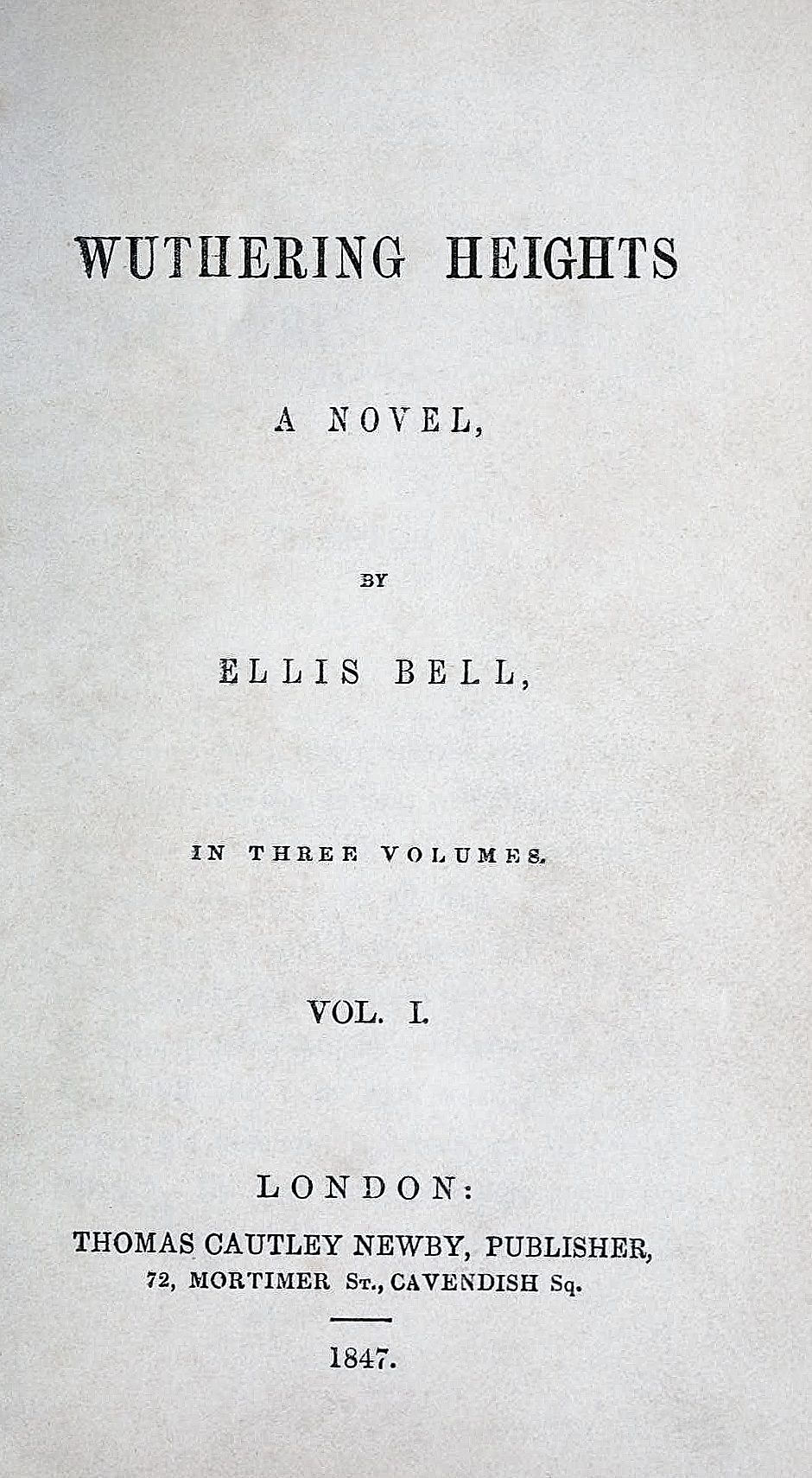
Wuthering Heights, 1847
Source: Wikipedia
The tone of these passages may surprise you—this is biography, remember, not fiction. But Gaskell’s biography is as lyrical and dramatic as any novel, and the more seasoned Brontë readers among you may well have been struck by something familiar.

Do you remember Lockwood’s dream from the opening section of Emily Brontë’s Wuthering Heights? Do you remember Heathcliff’s reaction to this dream?

I was lying in the oak closet, and I heard distinctly the gusty wind, and the driving of the snow; I heard, also, the fir bough repeat its teasing sound, and ascribed it to the right cause: but it annoyed me so much, that I resolved to silence it, if possible; and, I thought, I rose and endeavoured to unhasp the casement. The hook was soldered into the staple: a circumstance observed by me when awake, but forgotten. ‘I must stop it, nevertheless!’ I muttered, knocking my knuckles through the glass, and stretching an arm out to seize the importunate branch; instead of which, my fingers closed on the fingers of a little, ice-cold hand! The intense horror of nightmare came over me: I tried to draw back my arm, but the hand clung to it, and a most melancholy voice sobbed, ‘Let me in—let me in!’ ‘Who are you?’ I asked, struggling, meanwhile, to disengage myself. ‘Catherine Linton,’ it replied, shiveringly […] ‘I’m come home: I’d lost my way on the moor!’ (20) 

[Heathcliff] got on to the bed, and wrenched open the lattice, bursting, as he pulled at it, into an uncontrollable passion of tears. ‘Come in! come in!’ he sobbed. ‘Cathy, do come. Oh, do—once more! Oh! my heart’s darling! hear me this time—Catherine, at last!’ The spectre showed a spectre’s ordinary caprice: it gave no sign of being; but the snow and wind whirled wildly through, even reaching my station, and blowing out the light. (24) 
Emily Bronte, Wuthering Heights, ed. by Ian Jack (Oxford: Oxford University Press, 2009)

Gaskell transforms Charlotte Brontë’s act of pacing—and thus her continued attempts to write—into a ghostly haunting, employing a direct and explicit (yet unnamed, unspoken) allusion to her dead sister’s only novel. Thus she blurs the dividing line between life narrative and fiction. The biography appropriates the energy and fantasy of Emily’s novel, and strange moments like this punctuate Gaskell’s text. They typically deal with Brontë as a writer, whereas realist narratives are used to depict Brontë as a ‘proper’ woman. Here, therefore, the ghostly allusion to Wuthering Heights serves to displace Brontë’s act of writing, making it somehow ‘unreal’, strange and supernatural.

The allusiveness of Gaskell’s biography, its use and borrowing from a range of texts (declared or otherwise), reveals the permeable nature of genres and the artificiality of separate traditions where fiction and non-fiction are rendered asunder.